
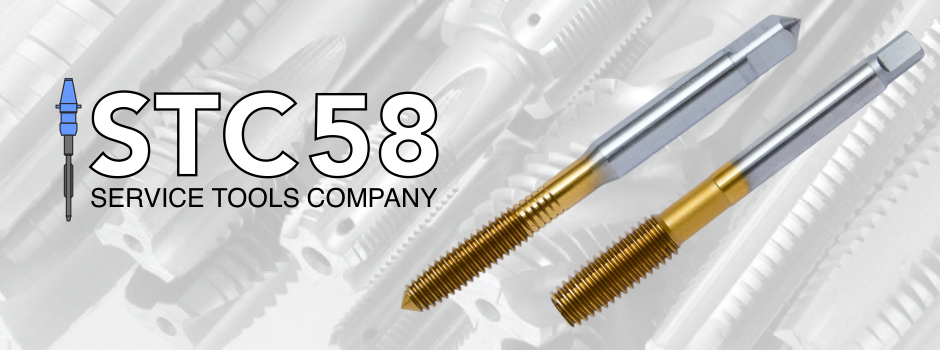
The key difference between STC58 taps and traditional cutting taps is the shaping of the profile by rolling rather than cutting the material. This eliminates the formation of chips, which is especially in demand when working with blind holes and in closed enclosures (instrumentation, electronics). Due to the riveting of the surface layer, the resulting thread demonstrates increased resistance to cyclic loads - the solution is relevant for critical components in mechanical engineering.
Springless taps (or rollers) are used for cutting internal metric threads manually using a collar. The teeth of the tap sequentially remove the material from the walls of the prepared hole, forming a threaded profile.

|
The pitch of the thread must match the pitch of the mating screw or bolt. The diameter of the drill is selected according to the table for the selected threaded combination, taking into account the processed material. A hole that is too narrow increases the load on the tap, and a hole that is too wide reduces the completeness of the threaded profile.
Before starting work, the workpiece is fixed, and an entry chamfer is made at the entrance to the hole. The square of the shank is securely fixed in a suitable collar. When the tap enters, its position is maintained along the axis of the hole, preventing it from tilting under the force of the collar. If the tool is included in the kit, follow the sequence of passes indicated on the label.
For a blind hole, a depth reserve is provided for the entrance part and an accumulation of chips. The coolant is selected according to the material of the workpiece. During the cutting process, the grooves are cleaned and the rotational force is controlled: a sharp increase in resistance requires stopping and checking the tool.
Application areas
- mechanical engineering (nodes with high cyclic load - the thread is stronger due to the hardening of the surface layer);
- instrumentation and electronics (minimizing chips in enclosed enclosures);
- repair and maintenance (restoration/shaping of threads in blind holes without the risk of jamming from chips);
- serial production of parts made of plastic materials (aluminum alloys, copper, brass, low carbon steels).
Advantages in use
- the absence of chips is critical for blind holes and closed cavities;
- increased thread strength and wear resistance due to riveting;
- higher profile accuracy and lower roughness (Ra 1.6–3.2 microns);
- increased tool life (absence of cutting edges and grooves reduces the risk of chipping and breakage);
- the ability to process deep holes (up to 3-4×D) without chip removal problems.
Restrictions
- applicable only to plastic materials (hardness up to 40 HRC);
- require an increased diameter of the pre-hole (according to the manufacturer's tables, not according to the tables for cutting taps);
- create more torque - when used manually, you need a powerful hand crank and high-quality coolant (oil formulations of 6-12% concentration).