
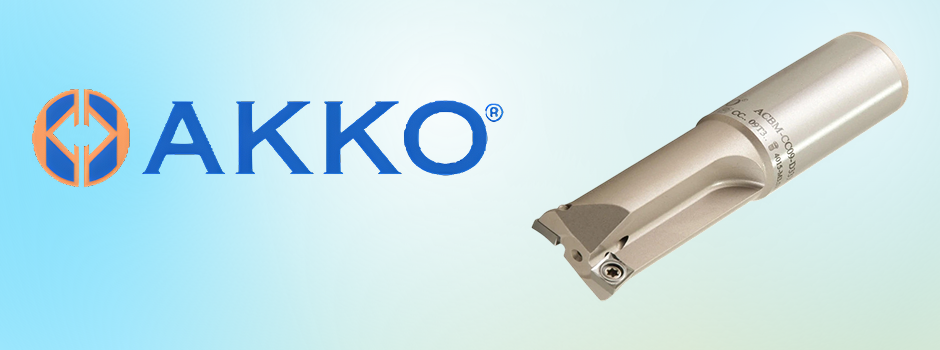
Countersinks are designed to form holes for screws with cylindrical and hexagonal heads according to DIN 974‑1 and are suitable for a wide range of materials — from structural steels to aluminum and titanium alloys. The key advantage of the models remains the internal coolant supply, which increases tool life and processing quality.
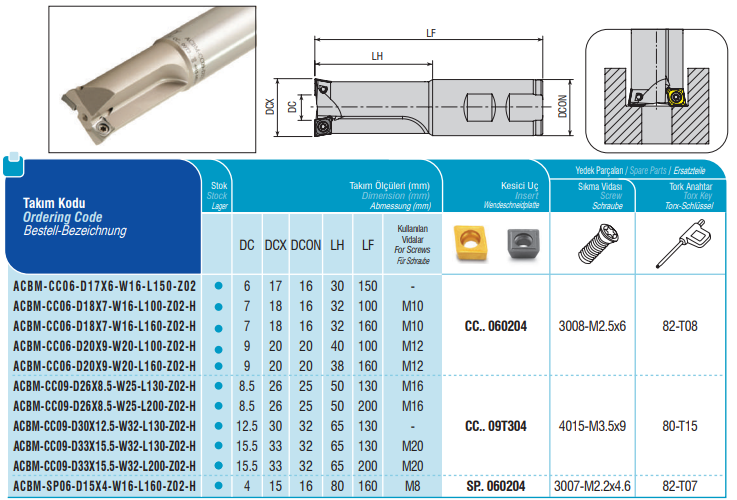
ACBM-CC06 countersinks
Some models:
- ACBM-CC06-D17X6-W16-L150-Z02.
- ACBM-CC06-D20X9-W20-L100-Z02-H.
- ACBM-CC06-D18X7-W16-L160-Z02-H.
Characteristics:
- Suitable inserts: CC..0602...
- Shank type: Weldon.
- Number of teeth: 2.
- Internal coolant supply: available.
ACBM-CC09 countersinks
Some models:
- ACBM-CC09-D26X8.5-W25-L200-Z02-H.
- ACBM-CC09-D33X15.5-W32-L200-Z02-H.
- ACBM-CC09-D30X12.5-W32-L130-Z02-H.
Characteristics:
- Suitable inserts: CC..09T3...
- Shank type: Weldon.
- Number of teeth: 2.
- Internal coolant supply: available.
|
Advantages of ACBM‑CC06 and ACBM‑CC09 countersinks
- High performance. Thanks to the optimized geometry of the cutting edges and the use of the latest‑generation hard alloys, countersinks ensure stable machining and allow for an increase in cutting speed — in some cases, productivity increases by 15–20 % compared to analogues from earlier series.
- Durability and cost‑effectiveness. Replaceable inserts significantly extend the tool’s service life: when worn, it is enough to replace only the insert, not the entire body. The service life of the inserts is increased thanks to wear‑resistant coatings and a well‑thought‑out mounting design.
- Effective cooling of the cutting zone. Internal supply of coolant through the tool body reduces the temperature in the contact zone, decreases the thermal load on the cutting edge, and thereby increases the wear resistance of the inserts, as well as improves the quality of the machined surface.
- Versatility of mounting and compatibility.The Weldon-type shank is securely fixed in the chuck, preventing rotation under high loads. The tool is compatible with inserts according to the ISO standard, as well as with solutions from leading manufacturers (Sandvik Coromant, Iscar, Kennametal, etc.), which provides flexibility in selecting the appropriate tooling for a specific task.
- Stability and accuracy. The rigid body design and precise positioning of the inserts ensure dimensional repeatability and high‑quality chamfering/socketing for the screw head, which is critical for mass production.
- Adaptation for automation. Counterbores are designed for use on CNC machines, in automatic lines, and machining centers; the design minimizes vibrations and ensures predictable tool behavior under programmable cutting modes.
Areas of application
- Mechanical engineering and machine tool construction. Creating mounting holes for screws with cylindrical and hexagonal heads in body parts, brackets, plates, and other elements.
- Automotive manufacturing and auto components. Processing fastening holes in chassis parts, body components, and suspension elements, where accuracy and repeatability are important.
- Aircraft manufacturing and the aerospace industry. Manufacturing of components from aluminum, titanium alloys, and high‑strength steels, where consistent processing quality and control of chip formation are required.
- Production of metal structures and welded components. Preparation of holes for fasteners in load‑bearing and auxiliary structures, including in serial production conditions.
- Instrumentation and electronics. Precise machining of holes in housings, mounting plates, and brackets, where surface finish and minimal dimensional deviations are important.
- Repair and maintenance work. Restoration of mounting locations for fasteners, correction of hole defects, deburring, and chamfering during equipment repair.
“We strive to offer solutions that not only meet current production requirements but also help our customers reduce the cost of operations,” said an AKKO representative. “Thanks to the modular design and improved geometry of the cutting part, the countersink allows us to reduce changeover time and improve quality stability.”