
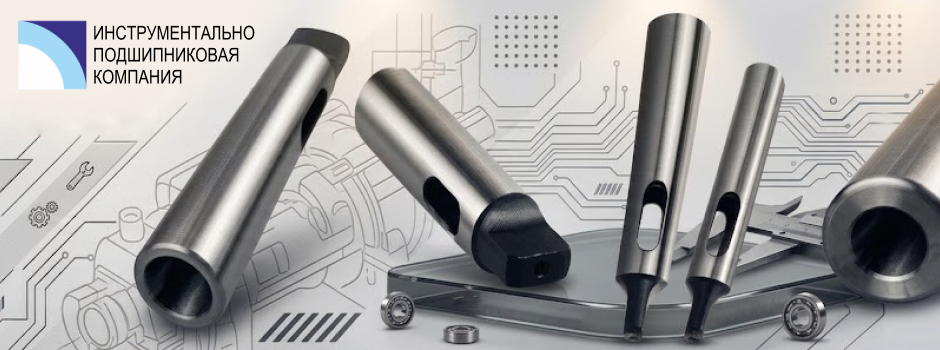
Specialists from the Tool & Bearing Company (IPK) have prepared a practical guide to help you navigate the nuances of selection and avoid typical mistakes.
What is a reduction sleeve and where is it used?
The design of a reduction sleeve (adapter sleeve) is simple: it is an adapter with external and internal tapers of different sizes. Its main job is to "match" a tool with a smaller shank size to a larger spindle taper socket. A classic example: you have a drill bit with an MT2 taper, but your machine is designed for MT4. In this case, a sleeve labeled MT4/MT2 is the ideal solution.
Such adapters are widely required when mounting:
- drills, countersinks, and reamers;
- taps and boring tools;
- live and dead centers;
- milling arbors.
They are used on lathe, drilling, milling, and boring machines, including CNC equipment.
How to determine the size and make the right choice
The most common mistake is confusing taper numbers. In production, sizes from MT1 to MT6 are most frequently encountered. The higher the number, the larger the diameter and the higher the allowable load. MT2 and MT3 are typically found on small and general-purpose machines, while MT5–MT6 are the realm of heavy industrial equipment.
The selection algorithm is extremely simple and consists of three steps:
- Find out the spindle taper — check the machine manual or the equipment nameplate.
- Look at the tool shank — the marking (for example, MT2) is often stamped directly on it.
- Select the sleeve using the formula: outer taper = spindle taper, inner taper = shank taper.
Adapters MT2/MT1, MT3/MT1, MT3/MT2, MT4/MT2, MT4/MT3, MT5/MT3, MT5/MT4, MT6/MT4, MT6/MT5 are in the highest demand. These exact standard sizes cover 90% of the needs of general-purpose workshops.
What to look for when buying
Skimping on adapter sleeves is one of the most expensive mistakes. Here are three key criteria that guarantee long and accurate performance:
- Manufacturing quality. The sleeve must provide a perfect fit without the slightest play. Any gap leads to runout and premature spindle wear.
- Material. Professional sleeves are made from hardened tool steel. This provides high wear resistance and allows them to withstand heavy loads.
- Design features. The presence of a tang for locking or a drift slot simplifies installation and removal, but it is important to consider your machine's design here.
Mistakes that shorten machine life
The biggest problems arise in three cases:
- Incorrectly determined size. Attempting to install MT3 into an MT2 socket results in damage to the mating surfaces.
- "Stacking" sleeves. Installing a tool using two or three adapter sleeves intentionally reduces the rigidity of the system and induces runout. Use only one sleeve of the required size.
- Ignoring damage. Even a small score mark or corrosion on the taper makes the tooling unsuitable for precise work. Inspect the condition of all mating surfaces before every installation.
When it's time to replace the sleeve
Replacement must be carried out immediately if you find:
- cracks or chips on the body;
- deep score marks or traces of slipping;
- noticeable wear on the conical surface.
Operating such tooling is risky — repairing the spindle will cost many times more than buying a new sleeve.
Frequently Asked Questions
Can several sleeves be used at the same time?
Technically it is possible, but highly undesirable due to the reduction in rigidity and system accuracy.
How do I find out the Morse taper size?
The size is usually specified in the machine documentation or marked on the tool.
What does the MT4/MT2 designation mean?
The outer taper of the sleeve is size MT4, and the inner taper is MT2.
Why does runout occur after installing the sleeve?
The reasons could be contamination of the mating surfaces, wear on the sleeve, or incorrect size selection.
Can an old sleeve be used after long-term operation?
Only after checking the condition of the conical surfaces and ensuring there is no damage.
Where to buy reliable reduction sleeves
The range of the Tool & Bearing Company features a wide selection of reduction sleeves, live centers, and other machine tooling for lathe, drilling, and milling equipment.
If you are unsure about your choice or want to select the optimal solution for a specific production task, our specialists are always ready to advise you and help you make the right choice.