
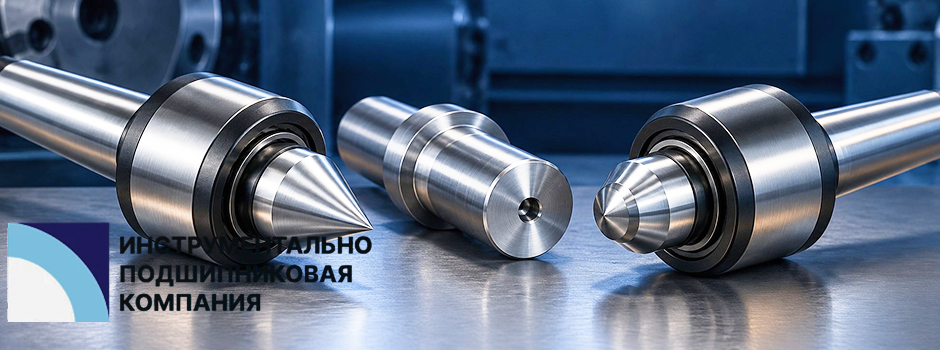
Despite the external simplicity of the design, there are several types of rotating centers, each of which is designed for specific working conditions. In this article, we will look at the main types of turning centers, their features and applications.
The rotating center is installed in the pinole of the headstock of the lathe and supports the workpiece during processing. Unlike the thrust (fixed) center, its working part rotates with the part due to the built-in bearings. Due to this, friction and heating are reduced when working at high speeds, wear of the center hole and vibrations are reduced, and the life of equipment and tools is increasing.
Design and operating principle
|
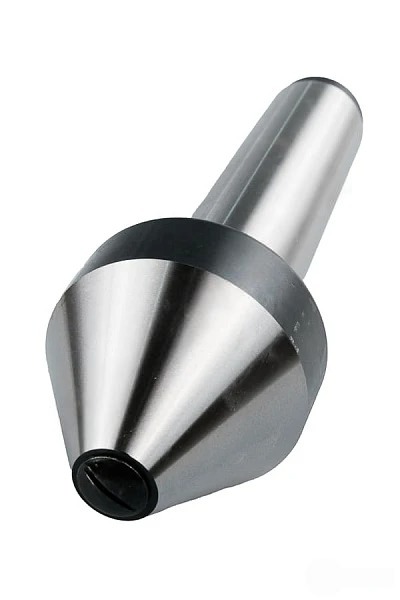
The classic rotating center consists of a conical Morse shank, a housing, a rotating tip, radial and thrust bearings, as well as protective seals. The bearing assembly allows the center to rotate with the workpiece and accept both radial and axial loads - this ensures stable operation even with intensive processing.
What are the types of rotating centers
The choice of the model depends on the nature of the tasks:
- Standard is a universal solution for machining shafts, axles and cylindrical parts; it is most in demand in mechanical engineering and repair shops.
- Reinforced - designed for heavy and bulky workpieces: rotors, large shafts, power and heavy machinery parts. It is characterized by increased bearings and increased load capacity.
- High-speed - for CNC machines and finishing: minimal runout, precision bearings, high-quality balancing.
- With an elongated tip - for parts of complex shapes and workpieces with limited access; in demand in tool manufacturing.
- With replaceable tips - an option for enterprises with frequent changes of nomenclature: quick replacement of the working part reduces the cost of tooling.
- For pipes and hollow workpieces - the special shape of the tip holds pipes, bushings and hollow shafts without deformation.
The tips also differ:
- Standard taper,
- Shortened,
- Elongated,
- Semi-center (for processing ends),
- Cup-shaped (for pipes and thin-walled parts).
What to look for when choosing
Experts recommend considering four parameters:
- Machine type (determines the size of the Morse cone - KM 2–KM 6),
- The mass of the workpiece,
- Processing speed,
- The required accuracy.
High-speed models with precision bearings are suitable for high revolutions, for finishing and CNC centers with minimal runout.
Separately, experts warn against typical mistakes: choosing an insufficiently powerful center, using a conventional model at high speeds, incorrectly selecting a Morse cone, and operating equipment with worn bearings. All this results in vibrations, deterioration of surface quality and accelerated wear of equipment.
The rotating center directly affects the machining accuracy, surface quality and machine life, so it needs to be selected for specific cutting modes and the type of parts to be processed.