
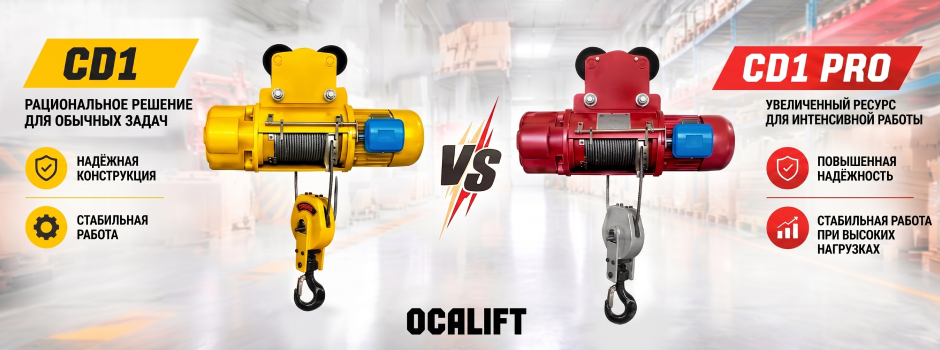
Consider a simple example. Two hoists share identical load capacity. The first is used only a few times per shift for occasional material handling operations. The second is integrated into the production process almost continuously, where an outage could bring a whole work area or assembly line to a complete halt.
In both cases, the equipment performs the same basic function: lifting and traveling with a load. However, the requirements for service life, duty cycle intensity, and reliability will vary considerably.
That is why, when choosing between the OCALIFT CD1 and CD1 PRO, it is essential to consider not just rated capacity and lift height, but above all the actual operating conditions and the intended duty cycle of the equipment.
OCALIFT CD1: A Practical Solution for Standard Industrial Applications
OCALIFT CD1 electric wire rope hoists are designed to lift loads and travel horizontally along an I-beam. The equipment can be used as an independent hoisting mechanism or integrated into crane systems, including monorail and single-girder bridge cranes.
The CD1 is a classic 380 V industrial hoist built for recurring lifting operations under standard operating conditions.
Its field-proven design and straightforward serviceability make this series a practical choice for manufacturing plants, warehouse facilities, maintenance workshops, and installation areas. All units undergo factory testing and include a 12-month warranty.
The OCALIFT CD1 is the sensible choice when you need dependable equipment for standard lifting and travel duties without high-intensity operating requirements.
Typical Applications:
- Warehousing complexes and material storage yards;
- Loading and unloading operations;
- Maintenance and service shops;
- Production areas with standard hoisting cycle frequency;
- Equipment installation and positioning;
- Equipping overhead cranes and other hoisting setups.
The line includes models with diverse lifting capacities and heights, making it easy to select the optimal unit for any specific workstation profile.
CD1 PRO: Focused on Extended Service Life
The fundamental difference between the OCALIFT CD1 PRO and the base version is not their general function—both series are built to lift and transport loads. The main distinction lies in component service life and readiness for more demanding duty cycles.
Externally, the differences between the CD1 and CD1 PRO may not be obvious at first glance, as the PRO version's key advantages come down to premium internal components and heavy-duty durability.
There are also specific design and operational refinements. For instance, the CD1 PRO series comes pre-filled with gearbox oil, whereas the standard CD1 includes oil supplied separately in the box. However, this is simply a convenience detail rather than the line's defining advantage.
The primary feature of the CD1 PRO is its extended operating lifespan, which becomes crucial during frequent and heavy duty cycles.
When evaluating both models, assess not only the upfront purchase price of the hoist, but also duty duration, switching frequency, load spectrum, and the potential cost of unplanned downtime.
While the CD1 is the go-to value choice for standard operations, the CD1 PRO should be prioritized for manufacturing workflows with higher duty cycles, including continuous run time throughout shifts or multi-shift plant operations.
Equal Capacity Does Not Mean Equal Operating Conditions
Suppose a facility needs to handle loads weighing up to 2 tons. At first glance, the selection looks straightforward: a hoist with a 2-ton capacity.
However, correctly matching equipment to the task requires answering several further questions:
- How often will lifts be performed per hour?
- How many hours per shift will the hoist be under load?
- Will the hoist run on a daily or intermittent schedule?
- How close is the typical working load to the hoist's maximum rated capacity?
- Is the facility running single-shift or multi-shift schedules?
- How severe would unexpected hoisting downtime be to plant operations?
The answers to these questions pinpoint the exact technical requirements needed from the hoist.
If lifts occur at moderate frequencies and the unit is not tied to a continuous line cycle, the OCALIFT CD1 offers an optimal balance of technical capability and budget efficiency.
If the hoist runs constantly within a core production cycle where an unexpected breakdown risks idling operators or adjacent machinery, upgrading to the OCALIFT CD1 PRO with its extended service life is the smarter choice.
In short, base your purchase decision not only on how much weight the hoist can lift, but also on how often and under what conditions it must perform that work.
Why Upfront Price Is Not the Only Selection Metric
Comparing two units side-by-side makes price differences readily apparent. Yet in industrial environments, a far more critical metric is the total cost of ownership (TCO).
For an intermittently used hoist, paying extra for heavy-duty design headroom can be economically unjustified. In such cases, the standard CD1 gets the job done without overspending on capability you will not use.
In demanding, high-throughput environments, the calculation shifts completely.
Unscheduled hoist failure introduces costs far beyond simple repair bills. Depending on production design, it can stall entire workforces, bottleneck downstream processes, cause delivery delays, and generate significant administrative fallout.
That is why the CD1 PRO should be viewed not just as a higher-priced model, but as a deliberate safeguard for operating settings where heavy-duty endurance delivers tangible economic returns.
Sound procurement is not about defaulting to the most expensive model; it is about matching equipment rating and service life directly to real-world duty cycles.
CD1 vs. CD1 PRO: Which One Should You Choose?
For an initial assessment, keep this general rule of thumb in mind:
OCALIFT CD1 is the best match for standard industrial duties, routine lifting tasks, and moderate-intensity cycles.
OCALIFT CD1 PRO is built for higher-demand workflows, constant production duties, and facilities where maximum endurance and eliminating unscheduled downtime are top priorities.
The final hoist selection should be guided by your complete operational profile: rated capacity, lift height, lift frequency, shift duration, typical load distribution, and environmental conditions.
The golden rule: avoid paying for surplus duty cycle ratings you will never tap into, but never cut corners on durability where equipment uptime directly drives the manufacturing process.
The right hoist is not necessarily the most expensive unit available. It is the hoist whose specifications and rated service life match the actual work demands and daily conditions of your facility.
Learn more about OCALIFT CD1 and CD1 PRO electric wire rope hoists on the official OCALIFT website.