
SKOLE sponges are suitable for processing wood, paint and varnish coatings, putty, plaster, and metal. Thanks to their foam base and aluminum oxide abrasive, they effectively remove material while remaining comfortable even during prolonged work. An important advantage is the possibility of dry and wet sanding: moistening reduces dust generation and extends the service life of the abrasive. In addition, aluminum oxide is less prone to clogging, which is especially valuable under intensive use.
Where are SKOLE sponges used
In practice, the scope of application is wider than it seems at first glance:
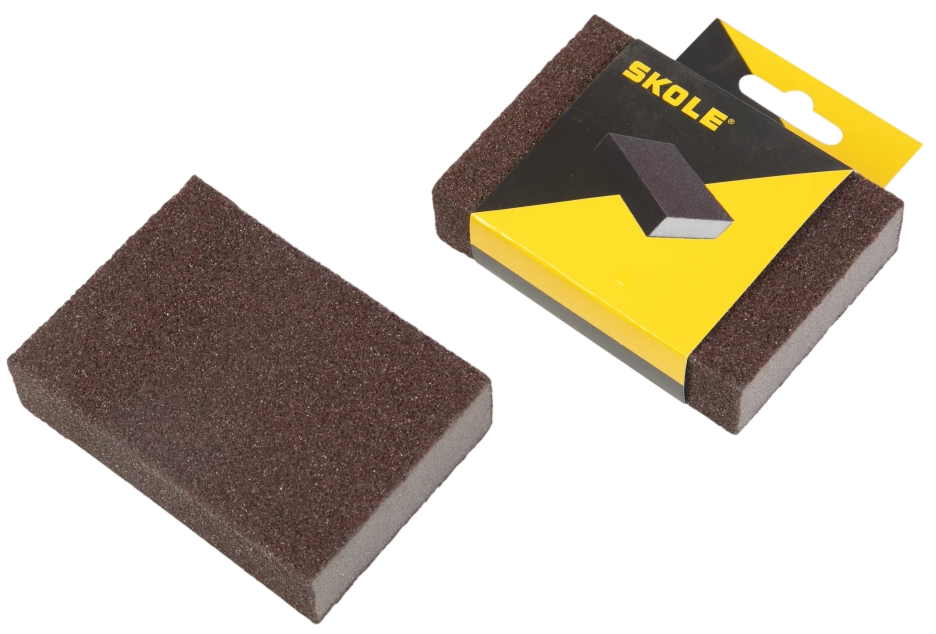
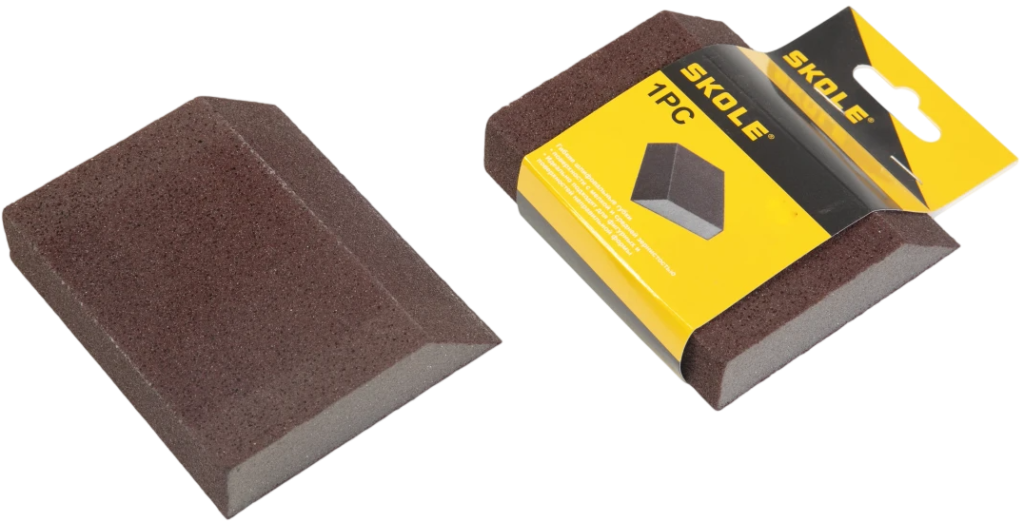
- Furniture manufacturing and carpentry. Trapezoidal sponges (GS2, GS4 series) are indispensable for processing edges, corners, and profiled elements — places that are difficult to reach with conventional abrasives. Rectangular sponges (GS1, GS3) are used for sanding facades, tabletops, and large parts.
- Repair and finishing. When preparing walls for painting or wallpapering, a sponge helps to quickly and neatly align the joints of putty and plaster, and smooth out minor irregularities. Water resistance allows you to work with a moistened surface — this reduces the amount of dust and improves the quality of the finish.
- Restoration. For delicate removal of old varnish or contaminants from antique furniture or wooden elements, choose fine‑grit sponges (P220–P320 and higher). The compact size and soft base do not damage the wood, allowing you to preserve the original relief.
- Bodywork and locksmith work. On metal surfaces, sponges are used to remove pitting, clean welds, and prepare the area for painting. Aluminum oxide handles metal without unnecessarily removing material, which is important when working with thin sheets.
- Working with complex shapes. In cases where the surface has curves, depressions, or complex relief (for example, decorative panels, casings, staircase elements), the trapezoidal shape provides precise control and allows you to avoid damaging adjacent areas.
Advantages of the SKOLE line
- Form to suit the task. Trapezoid — for corners, edges and joints; rectangle — for smooth and large areas.
- Wide range of grits. From P80 to P320 and higher: you can choose an option for each stage — from coarse layer removal to final polishing.
- Versatility in terms of materials and grinding methods. Suitable for wood, metal, paint and varnish, putty, and plaster; works in both dry and wet conditions.
- Comfort and durability. The soft base reduces strain on the hand, the water‑resistant design retains its performance characteristics for longer, and the aluminum oxide abrasive is less prone to clogging.
- Convenient storage and display. Packaging in a plastic bag with a cardboard suspension makes it easy to place goods on shelves and take them with you to the facility.
|
|
Practical recommendations for selection
To choose a sponge for a specific task, focus on two criteria: shape and grain.
| Task | Recommended form | Graininess |
|
Removal
of the old coating, coarse sanding |
Rectangular (GS1, GS3) | P80–P120 |
|
Processing of corners, edges, and joints |
Trapezoidal (GS2, GS4) | P100–P180 |
|
Finishing treatment, preparation for painting |
Any, depending on the area | P220–P320 |
|
Metalworking, removal of light corrosion |
Rectangular or trapezoidal | P120–P240 |
As a result, the SKOLE sponge line is not just a consumable, but a thoughtful tool that covers all the main grinding scenarios. Compactness, water resistance, and the right choice of shape and grain size allow the craftsman to work faster, cleaner, and more comfortably, regardless of the scale of the task.