
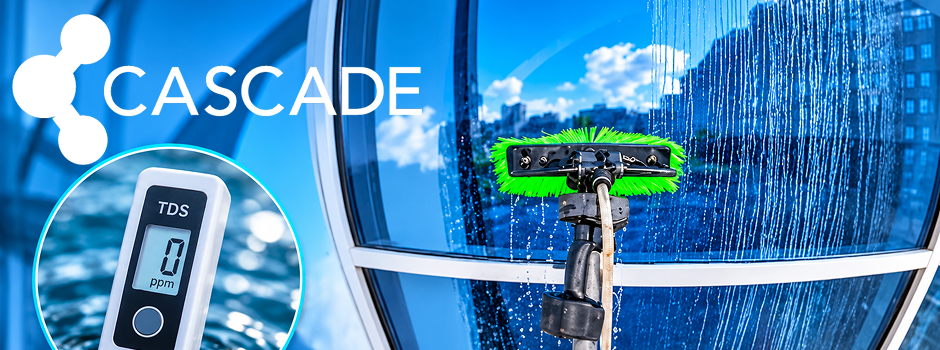
Professional cleaners often encounter a situation: the water treatment plant is operating normally, the TDS meter shows 0 ppm, the glass is thoroughly rinsed and left to dry, and after half an hour whitish dots, cloudy streaks or streaks from the upper frame appear on the facade. The customer had already noticed the problem, and the team was about to move on to the next section. Re-entry means additional time, water consumption, and the need to put the equipment out again.
7 reasons to check before washing the entire facade
- We checked the TDS once and decided that there was nothing wrong with the water.The TDS meter measures electrical conductivity and converts it into a conditional concentration of dissolved substances. A reading of 0 ppm only means that the concentration of conductive impurities is below the display threshold of the device. At the same time, water can carry dirt particles, organic pollutants, and detergent residues. It is useful to measure TDS directly on the work line after the treatment system, especially if the equipment is used for a long time or the source water varies from object to object.
- The resin has exhausted its life, but the station continues to operate. The depletion rate of the ion exchange resin depends on the mineralization of the source water and the volume passed through the system. Focusing only on the usual replacement period is easy to miss the moment of deterioration of cleaning. When using reverse osmosis, the condition of the membrane must also be taken into account: if it becomes worse at retaining salts, the load on the final deionization increases. Sequential measurement of TDS helps to understand — source water, water after reverse osmosis and after finishing treatment.
- Dirt continues to drip from the upper frame. One of the most common problems when working with WFP is contamination that comes out of the frames and seals after washing the glass. After drying, vertical streaks appear, starting at the upper edge of the double-glazed unit, while the TDS after the station may remain ideal. On heavily soiled glazing, it is first necessary to thoroughly rinse the upper frame and adjacent elements, wait for dirty water to drain and only then perform the final rinsing of the glass.
- The brush separated the dirt, but there was not enough water for rinsing. The presence of water on the glass does not indicate how well the dirt has been removed. With a weak flow or an unsuccessful feed angle, some areas are washed worse — near the edges and in the lower part of the double-glazed unit, remnants of contamination may linger. Sometimes it is enough to change the movement of the brush and increase the washing time of the problem area, but excessive water consumption alone does not solve the problem.
- With purified water, they try to remove impurities that need pretreatment.The WFP is well suited for regular maintenance, but road film, grease, bird droppings, glue, silicone, and mineral deposits may remain on the glass. A separate story is post—construction washing: particles of cement materials require careful handling, and an attempt to remove them with an unsuitable brush may result in damage to the glass. Before starting a large facility, it is useful to assess the nature of the contamination and do a test wash.
- The brush is dirty or does not adhere well to the glass. Worn pile, unsuitable rigidity or incorrect angle of fit worsen the machining. After working on heavily soiled frames, dirt particles sometimes linger in the pile, which, when moving to an adjacent double-glazed unit, return to the surface. The condition of the brush should be checked during the working day.
- There are traces of chemicals from previous car washes on the glass and frames. The first cleaning of an object with purified water sometimes turns out to be more difficult than subsequent ones, especially if the glazing was serviced in traditional ways for a long time before switching to the WFP. The remaining funds remain in the joints and near the seals, upon contact with water they are washed out and fall on the glass. A trial washing of a small area helps here.
By the nature of divorces, it is sometimes possible to understand where to look for the cause
If a problem occurs on the entire facade, you should first check the general conditions: water quality, equipment condition and rinsing technique. When footprints appear only on individual windows, it is wiser to start by examining these areas. By appearance, it is impossible to accurately determine the cause — the observation must be confirmed by water testing and trial treatment.
What to do if the stains are found after drying
You should start with TDS after the cleaning system. If the indicator meets the working requirements, inspect the problematic windows, upper frames and the brush. Then select a small area and repeat the washing, changing the stage that is suspicious. After complete drying, it will become clear whether the change has helped. The most expensive thing in such a situation is to repeat all the work without finding out the reason for the divorces.
Do I need to wipe the glass after the WFP?
One of the advantages of the WFP is the ability to leave the glass to dry naturally. With sufficiently purified water and proper washing technology, it is usually not necessary to additionally pass each window with a cloth or napkin.
This is especially important for high-rise work. The operator can handle the glazing with a rod, and the absence of mandatory manual wiping reduces the number of operations on each double-glazed unit.
However, natural drying imposes requirements on all previous stages. If there are any impurities left on the surface, they may become noticeable after the water has evaporated. Therefore, the quality of the result is determined even before the glass dries.
How to assemble a WFP kit to avoid typical problems
The water treatment system is an important part of the equipment, but the result depends on the entire working set. Professional washing also requires a suitable rod, brush, adapter, hoses, and water quality controls. Depending on the configuration of the system and the conditions of the facility, a pump and additional nozzles may be required.
The selection should take into account the height of the facade, the glazing area, access to water and the number of operators. The nature of the work is also important: regular maintenance of relatively clean windows imposes some requirements, while cleaning heavily soiled glazing imposes others.
How to avoid repeated facade cleaning
If streaks appear after washing with purified water, first check the TDS at the system outlet. Then evaluate the condition of the consumables and see exactly where the traces start from. Vertical drips from the upper profile, for example, give reason to check the frame and seals, and local cloudy areas — the quality of mechanical cleaning.
In case of difficult soiling and the first washing of an unfamiliar object, it is useful to conduct a test in a small area in advance. This allows you to evaluate the result after drying and, if necessary, change the technology before processing a large area.
The most expensive thing in such a situation is to repeat all the work without finding out the reason for the divorces. Several on-site inspections can save the team time and help avoid repeated customer complaints.