
At this stage, high speed is no longer an advantage. The operator needs something else: the ability to precisely control every movement of the load, stop the mechanism in a timely manner, and minimize load sway.
That is precisely why load capacity is not the only factor that matters when selecting a hoist for industrial installation. Creep speed, acceleration and deceleration dynamics, cross-travel controllability along the beam, headroom, duty cycle, and operating conditions all play a crucial role.
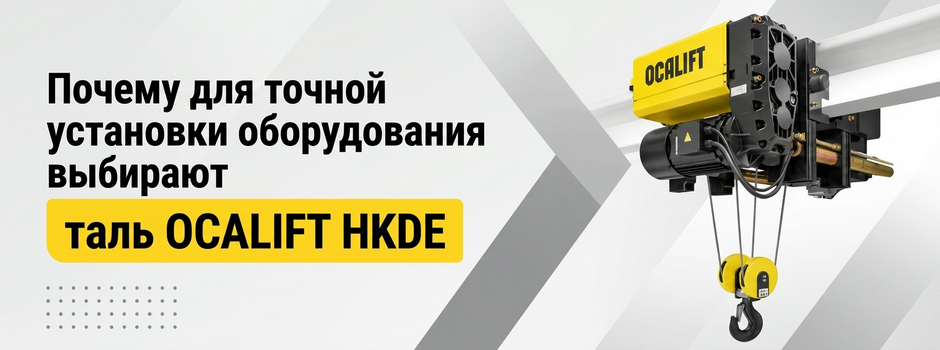
The OCALIFT HKDE is engineered specifically for such challenges. Dual-speed hoisting, variable-frequency travel drive, low headroom design, and standard radio remote control allow this hoist to be used wherever equipment is required not just to lift a load, but to deliver controlled and pinpoint handling.
Dual Hoisting Speeds: Move Fast — Position Accurately
Different stages of a lifting operation require different speeds.
During the main lift, productivity is key: the load must be brought to the target height without unnecessary delays. However, as it nears the installation point, the objective changes and precision comes to the fore.
The OCALIFT HKDE features both main and creep hoisting speeds. For instance, in the 3.2-ton capacity model, the speeds are 5 and 0.8 m/min.
The main speed is used for primary load travel, while the creep speed is utilized for final approach and micro-positioning.
At a speed of 0.8 m/min, the load travels a substantially shorter distance for the same button-press duration. This makes it much easier for the operator to monitor equipment positioning, stop the mechanism promptly, and complete a high-precision installation.
This capability is in particularly high demand when installing:
- industrial machinery and machine tools;
- electric motors and gearboxes;
- conveyor line sections;
- process equipment;
- structural steel components;
- machinery assemblies that demand exact alignment with foundations or mating parts.
Two speeds are not merely an extra feature. They provide the flexibility to leverage one mode for high throughput and the other wherever maximum load control is critical.
Variable-Frequency Drive Travel: Less Sway — More Control
Precision assembly involves more than just vertical movement. Once lifted, the load must travel along the beam, and it is during acceleration and braking that one of the most common issues arises: suspended load sway.
An abrupt start causes the load to swing away from the vertical due to inertia. A sudden stop keeps the oscillation going even after the trolley stops moving. The heavier and bulkier the load, the more effort the operator must devote to managing its dynamics.
On the OCALIFT HKDE, the travel trolley is equipped with a variable-frequency drive (VFD). Variable-frequency control ensures significantly smoother acceleration and deceleration of the hoist, mitigating the dynamic shocks that induce load swing.
And this is about far more than just operational convenience.
Mitigating Load Sway Is a Matter of Safety
Any operation involving lifting equipment demands heightened vigilance: a suspended load represents a potential hazard to personnel, equipment, and surrounding structures.
Load swing magnifies this hazard. A swinging load can drift dangerously close to machines, columns, structural frameworks, or other objects in the work area. When handling high-value machine tools and complex process assemblies, the cost of a mistake is measured not just in downtime, but in the steep expense of damaged equipment.
Therefore, smooth acceleration and braking should be regarded first and foremost as an essential element of safe and controlled load handling.
There is also another practical consideration: operator workload.
When a drive starts and stops abruptly, the crane operator is forced to constantly counteract load inertia: damping oscillations, waiting for swinging to subside, and making repeated inching adjustments.
Frequency control makes the mechanism's behavior far more predictable. The operator can readily anticipate how the load will react to commands, which reduces fatigue and allows them to focus directly on the path and precision of positioning.
In high-duty applications where dozens of such cycles are performed per shift, this becomes a major operational benefit.
Radio Remote Control Included as Standard
When performing high-accuracy machinery installation, the operator needs not only to operate the controls, but also to maintain a clear line of sight to both the load and the mounting location.
For this reason, radio remote control is included as standard equipment with the OCALIFT HKDE.
The operator is not tethered to a pendant station and can freely choose the vantage point that provides the best view of the load, its travel trajectory, and the installation zone.
The advantage of a wireless remote is particularly evident when mounting large-scale machine tools and heavy process assemblies, where it is impossible to monitor all critical clearance points from a single fixed position.
As a result, the operator can maneuver the hoist from wherever visual verification of the specific operation is safest and most ergonomic.
Low Headroom Design: Maximizing Available Shop Space
When choosing a hoist for an existing industrial facility, capacity is not the only constraint. In many cases, the primary bottleneck is vertical clearance.
Crane runways are already fixed, overhead trusses, pipework, and structural elements sit directly above, while the equipment being installed may have substantial dimensions.
Under these conditions, every centimeter of effective hook path is of critical value.
The OCALIFT HKDE is engineered in a low headroom configuration. The compact layout of the mechanism minimizes the distance between the beam flange and the hook saddle in its highest position, allowing you to maximize the use of available overhead space.
For a new facility, this provides greater flexibility when designing the material handling system. For an existing production hall, the benefit is even more evident: the compact hoist profile yields valuable additional lifting height without requiring structural modifications to the building.
Engineered Beyond Heated Workspaces
Industrial lifting equipment is frequently deployed in unheated warehouses, open manufacturing bays, and other harsh environments where ambient temperatures deviate significantly from standard indoor conditions.
The standard operating temperature range for the OCALIFT HKDE spans from −20 to +40 °C.
For facilities operating in more severe environments, cold-weather packages are available, rated for service from −40 to +40 °C.
This allows you to configure an HKDE unit not only by rated capacity, lifting height, or speed, but also according to the actual climatic demands of your specific facility.
Mechanism Protection and Operational Limit Controls
During intensive handling cycles, an operator must keep track of multiple parameters simultaneously: load orientation, travel path, hook elevation, proximity to structural elements, and the weight of the equipment being hoisted.
That is why the HKDE incorporates an integrated suite of safety devices designed to complement operator actions.
Depending on the configuration, the hoist is equipped with a digital load limiter, a 4-position adjustable rotary gear limit switch, and electronic overload protection.
These systems keep the mechanism operating within its certified boundaries and reduce the risk of entering dangerous operational states.
It is important to note: electronic safety devices do not replace adherence to safe operating procedures, rigorous rigging standards, and sound work site management. Their role is to establish an additional layer of technical oversight.
Built for Heavy-Duty Industrial Service
The OCALIFT HKDE is not built for occasional lifting; it is designed for continuous duty within industrial material handling installations.
An ISO 4301 M5 duty classification and up to 240 starts per hour in corresponding specifications enable the hoist to handle demanding production cycles reliably.
The enclosed drum structure and heavy-duty rope guide ensure uniform rope spooling, which is vital during frequent, high-cycle lifting and lowering routines.
Key Features of the OCALIFT HKDE
- Dual hoisting speeds — main speed for high productivity and creep speed for fine positioning.
- Variable-frequency travel drive — smoother acceleration and braking, minimizing dynamic forces and load sway.
- Standard radio remote control — freedom to choose the optimal perspective for line-of-sight monitoring.
- Low headroom design — efficient utilization of available overhead clearance.
- ISO 4301 M5 duty rating — engineered for intensive industrial operation.
- Up to 240 starts per hour — built for high-cycle production workflows.
- Integrated safety and limit systems — load monitoring, lift limit controls, and overload protection.
- Operating temperature range of −20 to +40 °C in standard execution.
- Low-temperature execution from −40 to +40 °C — for deployment in harsh climatic environments.
Specific technical specifications vary based on the rated lifting capacity and the selected HKDE configuration.
How the HKDE's Advantages Work in Synergy
Consider a typical industrial scenario: installing a multi-ton machine tool onto a prepared foundation in an operational plant.
First, the load must be hoisted and transferred to the assembly area. The main hoisting speed is engaged for this stage.
During travel along the runway beam, the variable-frequency drive ensures smooth motion. The hoist accelerates and decelerates without harsh jolts, allowing the operator to maintain firm control over the suspended mass.
As the machine approaches the foundation, rapid transit gives way to precision. The operator shifts to creep speed to carry out delicate, millimeter-accurate positioning.
Operating via wireless remote, the technician can stand in the ideal location to observe the machine, the anchor bolts, and surrounding machinery simultaneously.
This sequence showcases the core design philosophy of the HKDE: move fast when speed drives throughput, slow down when precision is non-negotiable, and keep motion fully controlled throughout every phase.
OCALIFT HKDE — When Hoist Selection Goes Beyond Tonnage
Evaluating industrial hoists solely by lifting capacity and upfront price means overlooking a major portion of the operational capabilities that define actual daily performance.
For an industrial plant, true value lies in positioning accuracy, motion dynamics, available lift height, duty cycle performance, environmental resilience, ergonomic control, maintenance service, and spare parts availability.
This is why the OCALIFT HKDE is more than just a dual-speed wire rope hoist.
It is an industrial solution for facilities where the goal is not merely to pick up heavy tonnage, but to make every movement controlled, precise, and predictable.
Dual speeds ensure pinpoint landing. Variable-frequency cross-travel minimizes load swing. Radio remote control gives the operator total line-of-sight freedom. The low headroom construction maximizes facility clearance. And optional low-temperature ratings expand operating boundaries.
When load values are high, clearances are tight, and an installation error can cause machinery damage or worker injury, motion control is no longer a luxury feature. It becomes a primary selection criterion.
And it is for precisely these challenges that the OCALIFT HKDE was engineered.