
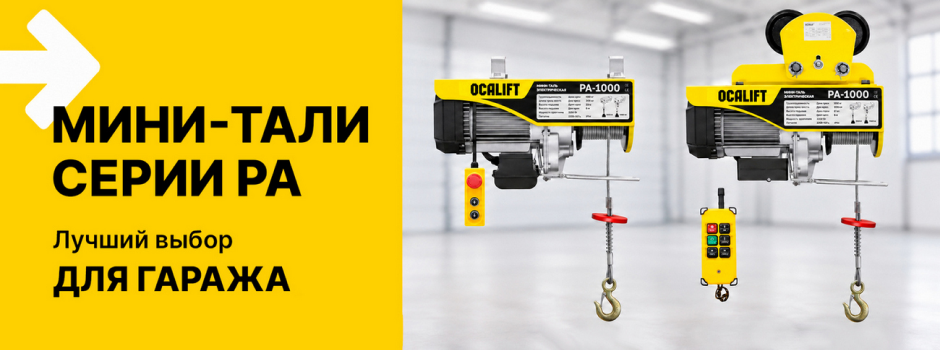
Let’s look at where such equipment proves useful, what models exist, and what factors to consider when choosing one.
Why Do You Need an Electric Mini Hoist in the Garage?
Automotive repair frequently involves lifting heavy components. An engine, gearbox, axle, or other assembly can weigh several hundred kilograms. Handling such loads manually is awkward, exhausting, and unsafe.
The OCALIFT PA-Series electric mini hoist mechanizes the lifting and lowering of heavy loads. Controlled via a pendant remote, it allows operators to manage heavy components without strenuous physical effort.
OCALIFT mini wire rope hoists are well-suited for a variety of tasks:
- Lifting car engines and transmissions during maintenance and repairs.
- Removing and installing heavy automotive assemblies and components.
- Lifting machinery, tooling, and heavy shop equipment.
- Moving goods between different workshop levels or mezzanine areas.
- Handling domestic utility and renovation projects around the garage.
It is important to note that a standard electric mini hoist is designed specifically for vertical lifting. Horizontal travel requires dedicated auxiliary equipment.
Why Choose OCALIFT Mini Hoists for Your Garage?
1. 220 V Mains Power Connection
One of the major advantages of the PA series is its operation from a standard single-phase 220 V electrical mains.
Operating an OCALIFT mini hoist does not require installing three-phase 380 V wiring. This makes it especially practical for private home garages, compact repair workshops, and service bays.
2. Compact Footprint
Unlike a mobile hydraulic engine crane (shop crane), an OCALIFT electric mini hoist mounts overhead onto a suitable load-bearing structure and takes up virtually no usable floor space.
This is critical for smaller garages where every square meter is needed for parking, tool storage, and workbench setups.
3. Remote Pendant Control
Lifting and lowering operations are executed with push buttons. The operator can comfortably monitor the entire process while remaining outside the hazardous load zone.
Select OCALIFT configurations can also be equipped with wireless radio remote controls. Specific configuration options should be confirmed upon ordering.
4. Capacity Doubling Capability
PA-series mini wire rope hoists can operate in either single-fall (single-line) or double-fall (double-line) reeving configurations using an included snatch block pulley.
This gives operators the flexibility to prioritize faster lifting speeds or doubled load capacity.
Single-Line vs. Double-Line Reeving: What’s the Difference?
A valuable design feature of the OCALIFT PA series is the integrated pulley block system (pulley tackle).
In a single-line setup, the load hooks directly onto the single wire rope. In a double-line setup, the wire rope is reeved through a pulley block, effectively doubling the rated lifting capacity while halving the lifting speed and total lifting height.
For instance, on the OCALIFT PA 250/500 mini hoist:
|
Specification |
Single Line |
Double Line |
|---|---|---|
|
Rated Load Capacity |
250 kg |
500 kg |
|
Lifting Speed* |
10 m/min |
5 m/min |
|
Lifting Height* |
12 m |
6 m |
Figures are provided for reference purposes. Precise specifications must be verified against the technical data sheet for your specific OCALIFT model.
In garages with standard ceiling heights, double-line reeving is often the preferred choice: while total hook travel is reduced, you gain the muscle to hoist much heavier assemblies safely within the rated load envelope.
Which OCALIFT Mini Hoist Should You Choose for Your Garage?
The OCALIFT PA series features models suited to various lifting capacity tiers.
|
Model |
Load Capacity |
Typical Applications |
|---|---|---|
|
OCALIFT PA 125/250 |
125/250 kg |
Compact workshops, motorcycle/powersports repair, tool lifting |
|
OCALIFT PA 250/500 |
250/500 kg |
Private garages, passenger car service and maintenance |
|
OCALIFT PA 500/1000 |
500/1000 kg |
Commercial auto repair shops, heavy drivetrain service, machinery maintenance |
OCALIFT PA 125/250 is ideal for lighter loads: individual auto parts, outboard boat engines, tooling, and motorcycle components.
OCALIFT PA 250/500 is an all-around workhorse for most garage operations. It is commonly selected for hoisting passenger vehicle engines and gearboxes, provided their actual weight stays within the working load limit.
OCALIFT PA 500/1000 is built for heavier loads and larger jobs. It is well-suited for professional repair shops working on SUVs, 4x4s, and light commercial vehicles (LCVs).
When selecting an OCALIFT hoist, consider not only the load weight but also lifting height, duty cycle, mounting method, and the structural rating of the overhead support.
Stationary or Traversing OCALIFT Mini Hoist?
The choice depends on the specific handling operations you plan to perform.
A stationary OCALIFT mini hoist is mounted in a fixed location—such as directly over an engine bay or a dedicated workbench. This is the right choice when tasks require only lifting and lowering.
A traversing OCALIFT mini hoist mounted to a compatible beam trolley allows horizontal load translation along an I-beam or monorail.
For example, during vehicle repair, you can hoist the engine straight out of the engine bay and then roll it along the beam to an engine stand or disassembly bench.
Ensure that the trolley, overhead beam, and mounting brackets all match the rated capacity of the hoist and the operational requirements.
What to Keep in Mind During Installation?
Even a compact electric hoist is regulated lifting equipment, requiring rigorous installation practices.
- Load-Bearing Structure Integrity. The OCALIFT hoist must be mounted onto a support structure engineered to withstand dynamic lifting loads. Standard garage ceiling joists or makeshift steel pipes are often inadequate.
- Strictly Vertical Lifting. OCALIFT PA-series mini hoists are not designed for side pulling or dragging loads across the floor. Lateral forces cause uneven wire rope winding and risk severe mechanical damage to the drum and drive.
- Load Limit Compliance. Never exceed the rated load capacity stated on the equipment plate. When using double-line reeving, adhere strictly to the reduced lifting height and speed ratings.
- Duty Cycle Adherence. PA-series hoists are designed for intermittent operational duty cycles. Operating intervals and required cooling periods are detailed in the product manual.
- Pre-Operation Inspection. Inspect the wire rope, hook, mounting fasteners, pendant controls, and limit switches before each shift as specified by the manufacturer.
It is strictly prohibited to stand beneath suspended loads or carry out repair work underneath an assembly supported solely by the hoist.
Why Consider OCALIFT?
When choosing lifting equipment, it is essential to look beyond the initial purchase price and rated load to consider long-term serviceability and technical support.
OCALIFT offers a comprehensive line of lifting and material handling solutions: from compact electric mini hoists to heavy-duty industrial cranes and winches.
Working with OCALIFT ensures you select equipment matched precisely to your application, clarify all technical parameters, and receive qualified advice on mounting configurations.
If your garage setup requires horizontal translation in addition to vertical hoisting, OCALIFT specialists can help you configure an integrated system with matching trolleys and monorail beams.
It is equally advisable to review warranty coverage, maintenance service terms, replacement part availability, and operating parameters beforehand.
When Is an OCALIFT Mini Hoist Most Effective?
Consider a few typical shop scenarios.
Scenario 1: Vehicle Engine Replacement.
Removing an engine requires controlled, steady extraction from the bay. When paired with a sound overhead support and correct capacity rating, an OCALIFT mini hoist accomplishes this smoothly without risky manual lifting.
Scenario 2: Handling Heavy Workshop Equipment.
Small fabrication shops regularly need to reposition bench machinery, cast-iron tooling, or welded assemblies. Rather than diverting multiple technicians from other tasks, an appropriately rated OCALIFT hoist allows a single operator to complete the lift safely.
Scenario 3: Restricted Garage Floor Space.
In confined spaces, maneuvering a hydraulic shop crane can be difficult or impossible. A ceiling- or beam-mounted OCALIFT mini hoist provides a dedicated overhead lifting station without sacrificing valuable floor room.
Bottom Line: Is an OCALIFT Mini Hoist Worth It for Your Garage?
If your garage or repair shop regularly handles heavy parts and machinery, an OCALIFT PA-series electric mini hoist is a practical and cost-effective investment.
It minimizes physical fatigue, streamlines repetitive lifting operations, and makes optimal use of available shop space.
The key to long-term success is selecting the appropriate load rating, ensuring a structurally sound mounting point, and adhering strictly to lifting safety protocols.
Explore and select OCALIFT PA-series electric mini hoists on the official website: ocalift.ru.
OCALIFT — lifting equipment tailored for tasks of any scale, from private garages to industrial manufacturing plants.