
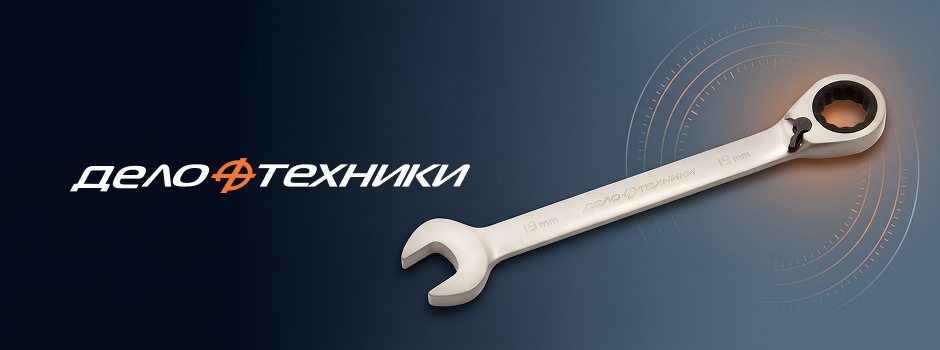
In tight spaces, a standard box-end wrench must be removed and repositioned after every short turn. A ratcheting wrench eliminates this step: the wrench stays on the fastener, while the handle simply moves back and forth. The more teeth a ratchet mechanism has, the smaller the arc required to engage the next tooth. Wrenches from "Delo Tekhniki" feature a 90-tooth mechanism, meaning the handle only needs to move 4°—a major advantage when there is almost no room to maneuver.
These wrenches are crafted from 6140 CrV (chrome-vanadium) steel, hardened to 44–48 HRC, and nickel-plated for corrosion resistance.
However, the ratchet mechanism has its limits—a point the manufacturer states explicitly: the ratcheting box end should not be used to break loose a tight fastener or to apply final, high-torque tightening. For those tasks, use the open-end side of the wrench or a socket. This is why all wrenches in this series are "combination" wrenches: the open end is used to break a nut loose or perform final tightening, while the ratcheting end allows for rapid threading or removal.
|
A specific design for every tight space
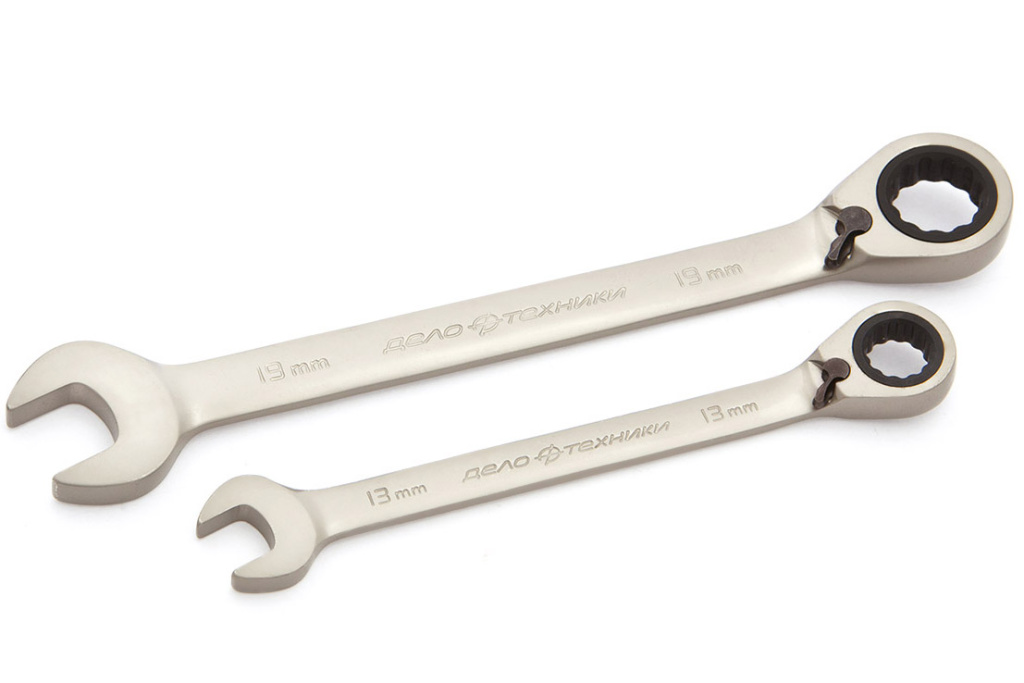
If you frequently need to change the direction of rotation but lack the space to flip the wrench over, the 5152 series is the right choice. It features a small lever built directly into the wrench body to toggle the ratchet direction, and the ring-end is offset from the axis by 10°. An example is the 12 mm ratcheting combination wrench with a direction switch.
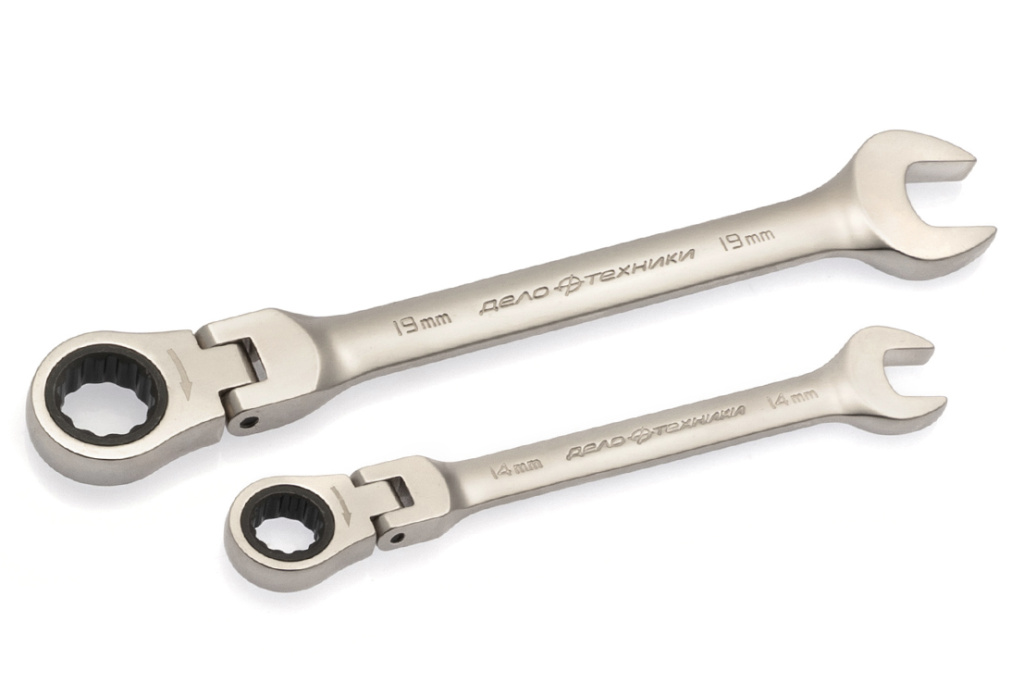
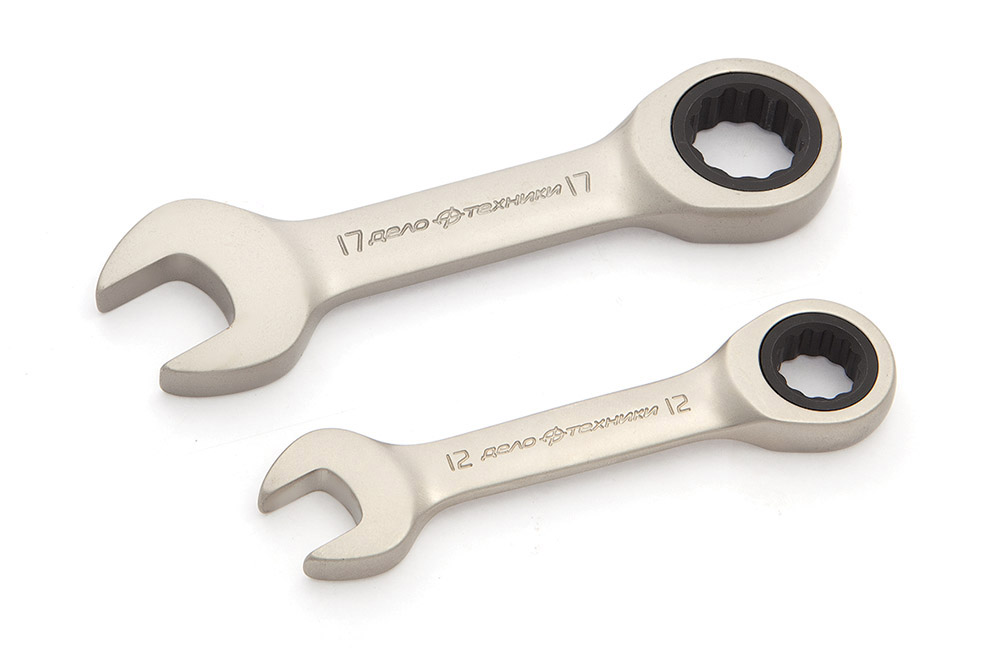
Sometimes, a nut cannot be reached with a standard, straight wrench. In such cases, the 5154 series is ideal: the ratchet mechanism is integrated into a swivel joint, allowing you to position the handle at a convenient angle—as seen in the 17 mm swivel-head ratcheting combination wrench. And if the length of the tool itself is the problem, there are the 5156 series short-pattern wrenches, such as the 10 mm short ratcheting combination wrench. They feature the same 90-tooth ratchet mechanism, yet the wrench can fit into spaces where a standard wrench’s handle would hit an obstruction.
|
|
Wrenches were the product category that launched the "Delo Tekhniki" brand. The company has been active in the tool market since 1994, and in 2001, it released its first series of wrenches under its own name. Today, the company operates its own laboratory, where it tests the chemical composition of the steel, as well as hardness, torque capacity, and the quality of the tool's finish.
The Enex catalog includes 87 "Delo Tekhniki" ratcheting wrenches, ranging from combination and double-ended types to extended-length box-end wrenches.