
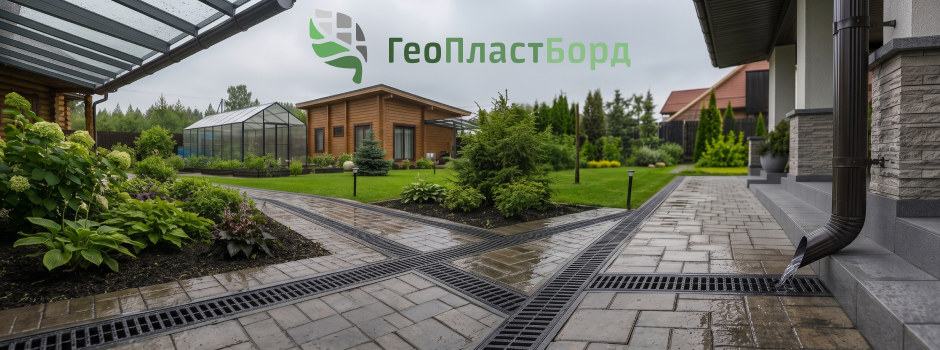
In this article, we will explain how to properly organize rainwater drainage from your property so that your paving stays smooth and level for decades.
Where Water Under Pavers Comes From: 3 Hidden Factors
Many property owners blame heavy downpours for everything, but the issue more often lies in engineering oversights made back during the landscape design phase.
Moisture lingers on walkways for three primary reasons:
- Improper grading. When the required slope is not maintained (which should be at least 1–2 cm per meter of length), water cannot drain by gravity.
- Sub-base settling. If the bedding layer beneath the pavers was poorly compacted, it settles over time, creating depressions and hollows.
- Uncontrolled runoff from adjacent areas. Water from lawns, foundation aprons, or roofs can flow onto pedestrian paths, overloading the filtration layers.
Consequences of neglect: If water pools for more than 2–3 hours after rain, it inevitably leads to the gradual leaching of cement laitance from the joints and the deterioration of the gravel base.
 |
Engineering Methods for Puddle Prevention
The choice of method depends on exactly where moisture accumulates. We highlight three common scenarios and turnkey solutions for each.
Scenario A: Puddles only on the walkway surface
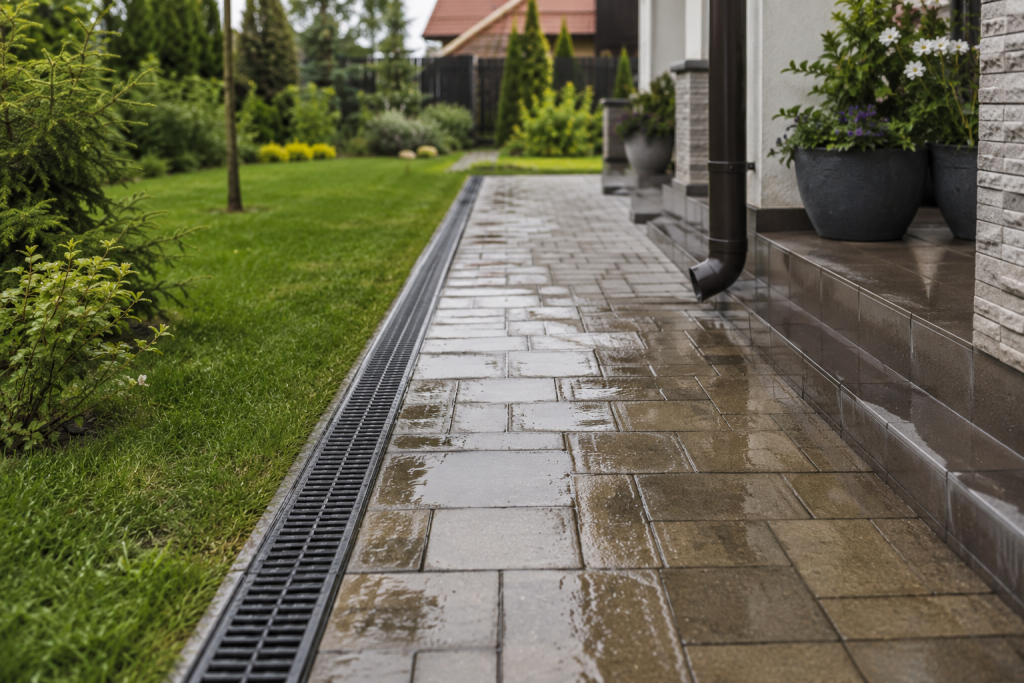
If water does not drain due to an insufficient slope or minor installation flaws, the optimal solution is installing a linear drainage system.
Drainage channels (trench drains) are installed along the curb of the paving. They intercept water and direct it into a drainage well or a stormwater sewer. Important: the channels must be set strictly below the finished surface level.
Scenario B: Runoff from a lawn or slope
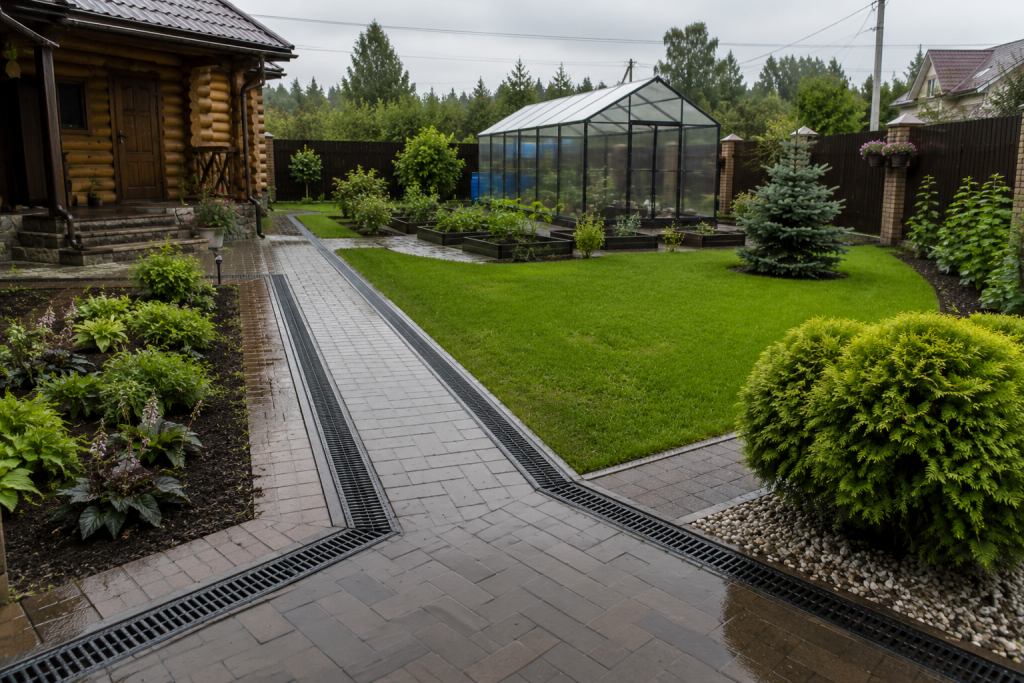
If water runs across the surface from surrounding areas, channels are installed not along, but across the flow — along the border between the lawn and the walkway. This creates a barrier that prevents runoff from reaching the pavers.
Scenario C: Roof runoff
This always calls for point drainage (catch basins / gully pots). A plastic box is installed directly beneath the downspout. It collects the surge volume of water and routes it through an underground pipe off the property.
 |
Step-by-Step Algorithm: How to Choose and Install a System
If you are planning comprehensive site protection, follow this checklist:
- Identify low spots. Visually inspect the property during rain or use a spirit/water level.
- Calculate load requirements. For pedestrian areas, plastic channels are sufficient. If a lawnmower or passenger car drives over the pathway, choose polymer concrete (it is stronger and will not crack in freezing temperatures).
- Plan debris protection. Always incorporate sand traps (catch basins) into the design. This will save you time on pipe cleaning — all debris and dirt will settle in a dedicated sediment basket rather than inside the pipes.
- Organize discharge. The most common mistake is collecting water into channels without providing an outlet beyond the property. You must account for a soakaway/drainage well or a connection to a central stormwater main.
5 Critical Installation Mistakes
To ensure your investment is not wasted, avoid these slip-ups (which are most common in low-cost contractor work):
- Laying pavers "by eye" without a level. A walkway should not be perfectly flat; it must be sloped.
- Directing roof downspouts straight onto the apron. This ruins both the foundation apron and the adjacent pavers in just 1–2 seasons.
- Elevating channels too high. If the drain grate protrudes above the pavers, water simply bypasses it instead of entering the channel.
- Omitting a concrete bedding. Channels are sometimes placed directly into the soil without a concrete foundation. Within a couple of years, frost heave will push them out.
- Skimping on corrugated pipe. When connecting to a collector, cheap corrugated pipes quickly silt up, causing the entire system to fail.
 |
Frequently Asked Questions (FAQ)
Question: Is it necessary to install drainage if puddles only appear after heavy rainfall?
Answer: Yes, it is essential. Even occasional standing water leads to the gradual saturation of the bearing layer beneath the pavement. Each time this happens, the sub-base loses some of its density, and in winter, moisture turns into ice, expands, and breaks apart the material structure. The longer you put off a solution, the more extensively the bedding layer beneath the pavers will deteriorate.
Question: Can drainage be installed after the pavers have already been laid?
Answer: Yes, this can be done without completely dismantling the paved surface. Trenches are cut along the walkway or in areas with the highest water accumulation to install drainage components, which are then connected to the stormwater disposal system. The main requirement is having a designated discharge point for the collected runoff.
Question: Which channels are best suited for garden walkways?
Answer: For pedestrian areas, plastic models with grates are most commonly used — they do not rust, are lightweight, and are easy to install. However, if vehicles might drive across the surface, consider polymer concrete or concrete units. They withstand significantly higher loads and offer increased wear resistance.
Question: Is a sand trap necessary?
Answer: Yes, installing one is strongly recommended. This unit traps sand particles, small debris, and fallen leaves, preventing them from entering the pipes. As a result, the drainage system clogs much less often and requires far less maintenance.
Question: Can I simply create a slope without installing drain channels?
Answer: In areas with light precipitation, a properly engineered slope can sometimes suffice. However, in regions with regular rainfall or substantial runoff from adjacent grounds, this measure alone is rarely effective. In such cases, installing a surface drainage system is a far more reliable solution.
Conclusion
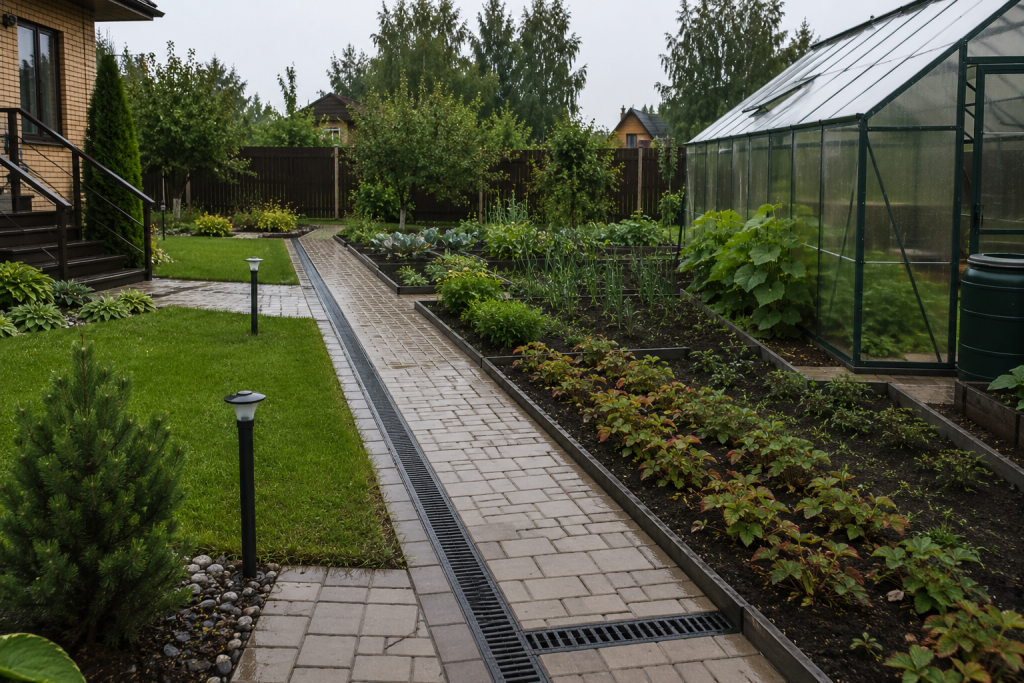
In most cases, getting rid of perpetual dampness on your property does not require a complete landscape overhaul. It is sufficient to properly intercept runoff — either before it reaches the walkway (transverse channels) or directly along the path (linear drainage system).
Remember: proper drainage is not just about keeping the area clean — it is an investment in the longevity of your hardscaping. Investing once in a stormwater system will save you from costly repaving down the road.