
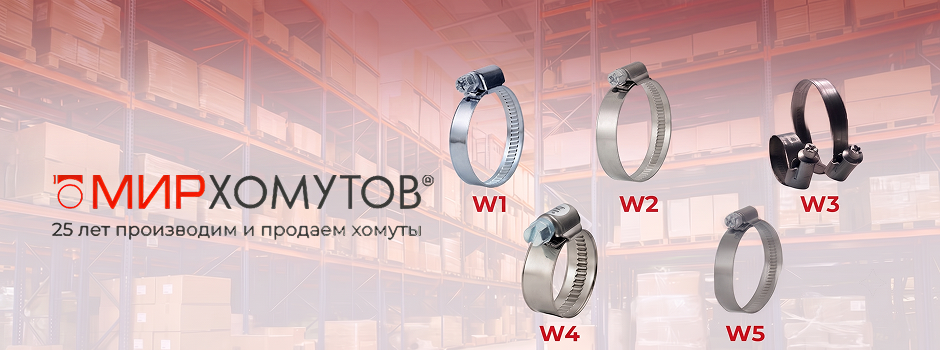
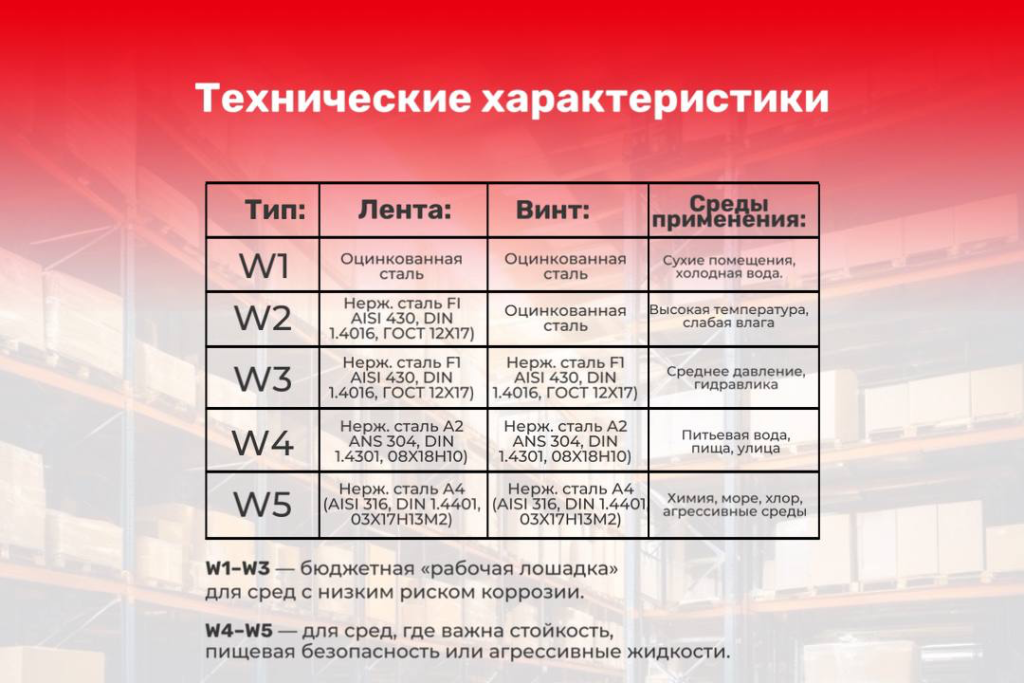
The main secret of the yoke's durability lies in the metal from which it is made. In international practice, the index W (from the German Werkstoff - material) is used to classify materials.
Let's take a closer look at the five main classes, from W1 to W5, so that you can choose the right fasteners for your needs without overpaying for unnecessary features.
|
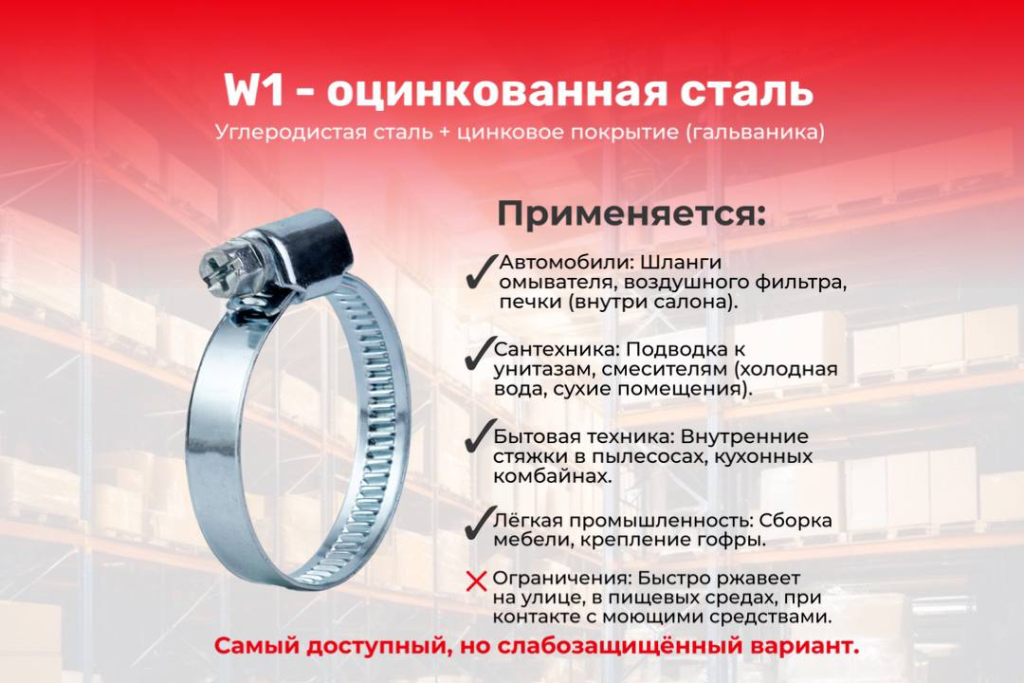
W1: Galvanized Steel (Budget Base)
The most common and affordable option on the market. It is made of carbon steel with a protective layer of zinc (galvanization) on top.
-
Where it will perform best: Ideal for dry rooms and non-aggressive environments. In cars, these clamps are installed in the cabin (for example, on the heater hoses) or in areas where water and road reagents do not reach. In everyday life, they are an excellent choice for assembling furniture, internal fasteners in vacuum cleaners, fixing corrugated pipes, or connecting cold water lines.
-
Vulnerabilities and limitations: Galvanized zinc does not resist moisture well. If exposed to direct contact with water, aggressive detergents, or food environments, this clamp will quickly begin to rust.
|
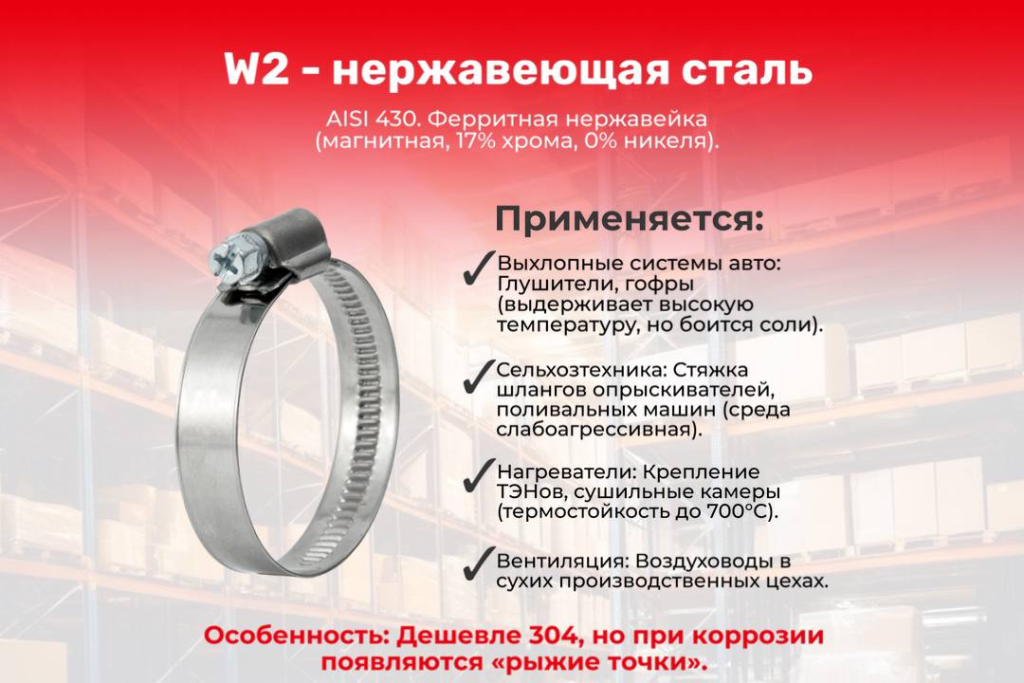
W2: AISI 430 Stainless Steel (Heat-Resistant)
This is a ferritic stainless steel that contains about 17% chromium but does not contain nickel. A distinctive feature of this alloy is that it is magnetic (this can be easily tested with a regular magnet).
-
Where it will perform best: The main advantage of W2 is its excellent resistance to high temperatures. The metal can withstand temperatures up to 700°C. This is why W2 has become the standard for car exhaust systems, heating elements, drying chambers, and air ducts in manufacturing facilities. It is also suitable for agricultural machinery that operates in mildly aggressive environments.
-
Vulnerabilities and limitations: Due to the lack of nickel, this alloy is less resistant to high humidity and salt. Prolonged exposure to moisture may cause cosmetic "red dots" on the surface.
|
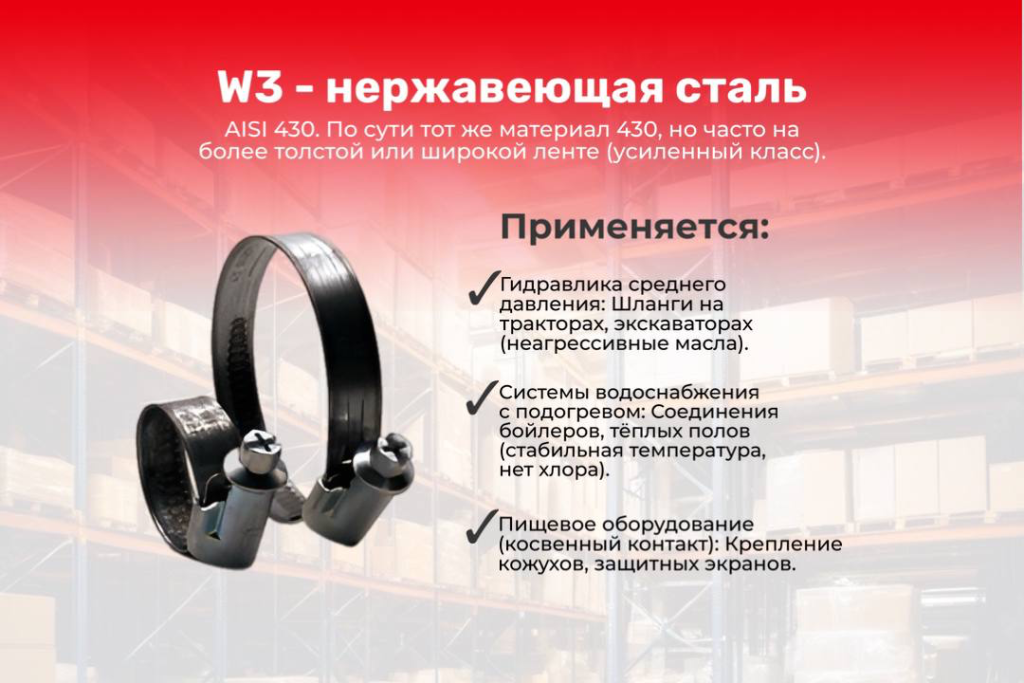
W3: AISI 430 Stainless Steel (Reinforced)
The chemical composition of the metal is identical to that of the W2 class. The main difference lies in the geometry of the product. The W3 class implies a reinforced structure, using a thicker or wider strip that can withstand increased mechanical stress.
-
Where will show itself best: In medium pressure systems. W3 clamps are excellent for hydraulic hoses on heavy equipment (tractors, excavators), where non-aggressive oils circulate. They are also widely used in water supply systems with a constant temperature difference (boilers, underfloor heating) and for fixing protective screens on equipment.
|
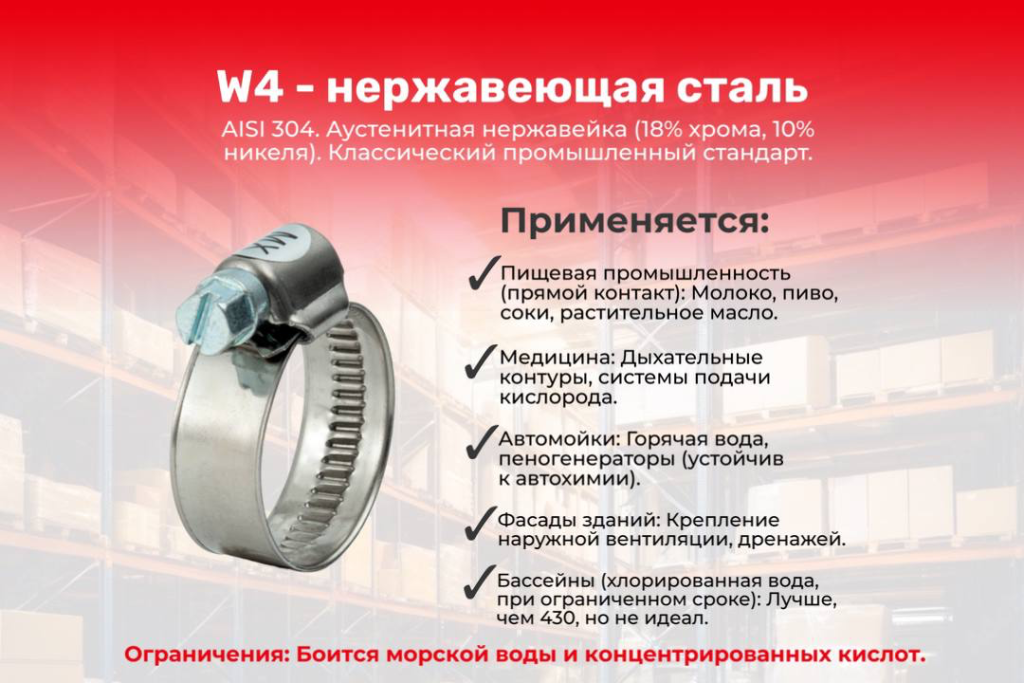
W4: AISI 304 Stainless Steel (Industrial Classic)
This is an austenitic stainless steel alloyed with chromium (18%) and nickel (10%). It is the true gold standard of the industry and is virtually non-magnetic.
-
Where it performs best: Due to its high nickel content, the metal has exceptional resistance to corrosion and chemicals. The alloy is environmentally friendly and can be used in direct contact with food products (such as milk, beer, and juices). W4 is an excellent choice for car washes (where caustic foam is used), medical oxygen systems, and outdoor ventilated facades.
-
Vulnerabilities and limitations: The metal copes well with fresh water and basic chemistry, but it fails against seawater (chlorides) and highly concentrated acids.
|
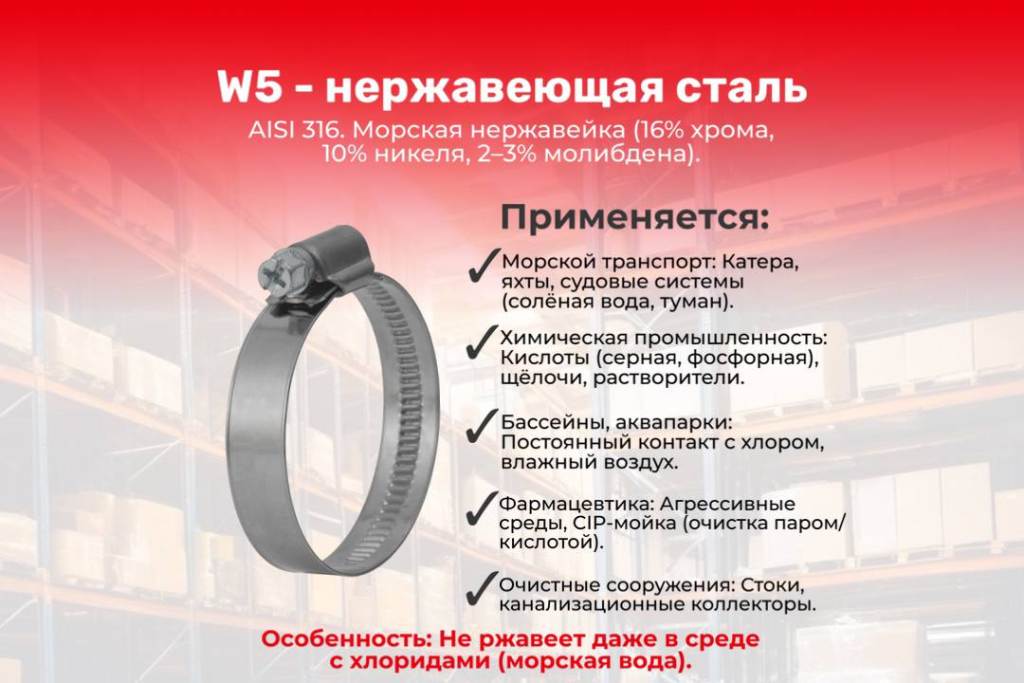
W5: Stainless steel AISI 316 (Marine and acid-resistant)
The premium segment. 2-3% molybdenum is added to chromium and nickel. It is molybdenum that makes steel invulnerable to pitting (pitting) corrosion even in the most extreme conditions.
-
Where it performs best: Where other metals are destroyed in a matter of weeks. This includes shipbuilding and boat equipment (constant salt fog and splashes). It also includes chemical plants that work with solvents and acids. It also includes pharmaceuticals, where harsh acid pipe cleaning is used. And, of course, swimming pools, water parks, and wastewater treatment plants with a high concentration of chlorine.
-
Vulnerabilities and limitations: None. The only deterrent is the high price. However, in aggressive environments, it is fully compensated by the reliable operation.
|