
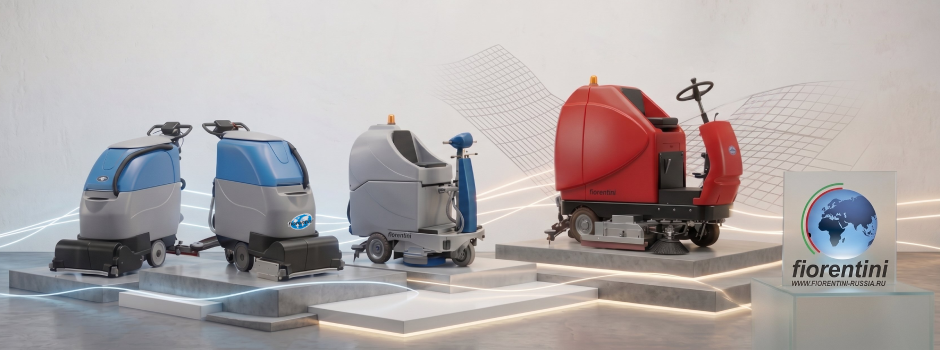
Professional floor cleaning is not just about motor power and detergent selection. The type of cleaning mechanism plays a key role: how the bristles make contact with the surface, flex, and move dirt particles. The Russian Fiorentini catalogue features GIAMPY machines with disc and cylindrical brushes, as well as orbital modules. Let us examine the specifics of each solution.
 |
Disc and Cylindrical Brushes: What is the Difference
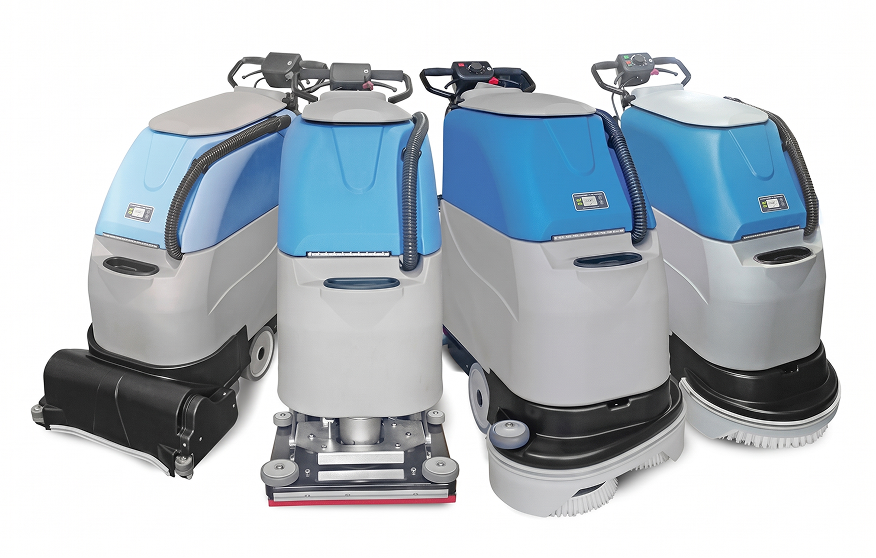
Disc brushes rotate around a vertical axis. The bristles clean the surface along circular trajectories, and the wide working surface is ideal for maintenance cleaning of smooth, even floors. This solution is especially suitable for retail halls, corridors, and other areas requiring regular cleaning of everyday soils.
Cylindrical brushes have a horizontal axis. Bristle rows come into contact with the floor sequentially along the length of the cylinder. In a dual-brush unit, counter-rotation directs debris into the collection hopper. It is this combination of washing and sweeping that makes cylindrical brushes particularly advantageous for warehouses and industrial facilities.
The orbital module is a distinct type of cleaning mechanism that performs frequent, short-stroke movements. It should not be referred to as a cylindrical or disc brush. The result depends on the selected pad and its compatibility with the floor surface; orbital motion alone does not ensure universality.
Advantages of Cylindrical Brushes
Warehouse floors typically have two types of contaminants: adhered grime and loose debris, such as sand, small crumbs, and packaging scraps. Simply dislodging them is not enough: the grime must be washed away, and the solid debris must be collected. The Fiorentini cylindrical brush unit combines both tasks.
In the GIAMPY 22 BR, two cylinders are arranged one behind the other, with their axes oriented perpendicular to the direction of travel. When viewed from one side, one brush rotates clockwise and the other counterclockwise. This counter-rotation means the bristles of the two cylinders move in opposite directions at the point of floor contact. As the machine advances, the front and rear brushes sequentially treat each section of the floor.
The bristle tip describes a circle in a vertical plane: it approaches the floor, makes contact, flexes under load, and lifts off the surface. The next row of bristles immediately follows.
What Happens in a Single Pass
The cleaning solution wets the dirt. The bristles mechanically detach it from the surface and agitate the particles. The counter-rotation in the GIAMPY 22 BR operates in conjunction with an integrated stainless steel debris hopper: solid debris is swept directly into it rather than accumulating in front of the squeegee. The squeegee then collects the dirty solution, which the vacuum system transfers into the recovery tank. Solid particles remain trapped in the hopper, while water carrying fine dirt enters the dirty water tank.
Why Cylindrical Brushes Perform Better on Textured Floors
The difference compared to a disc brush begins with the bristle path. A disc brush has a vertical axis, and the bristles travel in circular patterns along the floor surface. A cylindrical brush has a horizontal axis: each row of bristles repeatedly makes contact with the floor and lifts off. This results in a fundamentally different treatment of tile joints, grooves, and surface irregularities.
A disc brush cleans across a broad contact patch. A cylindrical brush touches the floor along a relatively narrow stripe; consequently, at an identical down pressure, the load can be concentrated over a smaller area. The relationship is simple: average pressure equals the applied force divided by the contact area. On an actual machine, both values depend on the suspension assembly, adjustments, and bristle deflection.
The bristles themselves must enter the depressions. When their length and elasticity match the surface, the cylindrical brush impacts not only the high spots of the profile: sequential rows reach into accessible recesses. The second brush cleans the same area with bristles moving in the opposite direction. However, this does not mean that every seam will be cleared regardless of its depth.
The Russian specification sheet for the GIAMPY 22 BR highlights the high rotational speed of the cylindrical brushes and their aggressive cleaning action on uneven surfaces. However, RPM cannot be compared in isolation from brush diameter: the linear speed of the bristle tip depends on both parameters. The exact multiple of advantage cannot be determined without comparative data for two specific machines.
Performance Comparison
|
Operating Principle |
Cylindrical Brushes |
Disc Brushes |
|---|---|---|
|
Bristle Motion |
Periodic contact and release; two cylinders rotate in opposite directions |
Circular motion along the floor around a vertical axis |
|
Surface Interaction |
Sequential action of bristle rows is ideal for profiled floors and accessible joints |
Wide contact zone is well suited for regular maintenance cleaning of smooth floors |
|
Loose Debris |
Combined with a hopper, enables simultaneous washing and debris collection in a single pass |
In standard machines without a sweeping unit, there is no separate collection of solid debris |
|
Consumables |
Front and rear brush positions must be strictly observed; they differ on the GIAMPY 22 BR |
On smooth floors free of loose debris, the disc-equipped ET 75 R remains a rational choice. On structured surfaces containing sand and debris, the combination of intensive washing and particulate collection offered by a cylindrical machine can eliminate the need for a separate sweeping pass. Long plastic wrap, strapping bands, and bulky items must still be removed beforehand, as they can wrap around the brushes or clog the collection hopper.
How to Maximize Cylindrical Brush Performance On-Site
Imagine cleaning non-slip tiles: the raised sections are already bright, but grime remains visible in the recesses. The machine may properly feed cleaning solution and recover water, yet that alone is insufficient: the bristles themselves must reach the dirt and remain in contact with it long enough to dislodge it. The three interrelated prerequisites for success are dwell/contact time, engagement with the surface profile, and unhindered evacuation of loosened debris.
Travel speed and brush RPM are distinct parameters. Brush RPM determines how frequently the bristle rows re-enter the contact area. Travel speed dictates how long that contact zone stays over a specific section of the floor. If travel speed is halved while maintaining brush RPM and footprint size, the dwell time over that section doubles. The number of bristle passes over it increases by roughly the same factor. This is a kinematic correlation, not an automatic guarantee of twice the cleaning outcome.
Therefore, on stubborn soil, reducing travel speed is often far more effective than simply increasing brush pressure. On the GIAMPY 22 BR, travel speed is modulated via the drive handle: the operator can adapt the pace to the floor conditions on the fly without changing machines. The chemical solution must also match the floor type and contamination; the brush complements the detergent's action rather than replacing it.
Why down pressure must match the bristles. If contact pressure is insufficient, some bristles may fail to reach the dirt. However, excessive force is equally counterproductive: it causes excessive bristle deflection, altering the angle of mechanical impact. A worn brush differs from a new one not just in bristle length, but also in geometry and elastic response. Compensating for bristle wear simply by applying more down pressure is incorrect. Permissible settings and replacement intervals should follow the manufacturer's specifications for that specific machine and brush.
The hopper and squeegee complete the cleaning cycle. Collected debris requires an unobstructed pathway. An overfilled hopper or fibers tangled around the cylinder will hinder debris pick-up even if the motors continue to spin the brushes. If the floor is clean but leaves water trails behind the machine, the squeegee assembly and vacuum system must be inspected: increasing brush down pressure will not rectify poor water recovery.
What to Check After a Pass
|
Symptom |
Primary Inspection Point |
|---|---|
|
Dirt remains predominantly in recesses |
Bristle suitability for the profile, bristle wear, machine travel speed, and chemical choice |
|
Solid debris remains behind the brushes |
Hopper fill level, tangled fibers, and whether debris size matches hopper capacity |
|
Floor is clean, but wet streaks remain |
Cleanliness and wear of squeegee blades, suction hoses, and dirty water recovery tank |
These symptoms help guide troubleshooting, but do not replace comprehensive maintenance diagnostics. Always inspect brushes and collection hoppers only after safely stopping and turning off the machine in accordance with its manual.
Why Cleaning Quality Depends on Bristle-to-Floor Contact
The advantage of cylindrical brushes on textured surfaces hinges on one specific condition: the bristles must physically reach the dirt and exert sufficient mechanical force to detach it from the surface. If the bristles pass over a recess, increasing RPM alone will not resolve the missed soil. Cleaning performance is governed by the dynamics of bristle-floor contact, not merely by a single speed or pressure metric.
From brush movement to contact force on dirt. Upon contact with the floor, the bristle deflects: its orientation and angle of attack relative to the surface change. Material composition, bristle length, and filament thickness determine its resistance to bending. Consequently, two brushes operating at the identical RPM do not necessarily deliver the same mechanical scrubbing effect. This phenomenon is detailed by Rauno Holopainen and Eero-Matti Salonen in their study on rotating duct cleaning brushes (Energy and Buildings, 2004). The authors modeled bristle deflection, contact forces, and tilt angles. In our context, this reinforces why bristle deformation and contact dynamics must be evaluated alongside rotational speed.
Why higher down pressure cannot substitute for proper contact geometry. Experiments conducted by UKAEA on robotic sweeping illustrate why a brute-force approach is not universally effective. Bechir Taoubi, Ioannis Zoulias, and Guy Burroughes evaluated the removal of flour, sand, and metal shavings. Under tested conditions, the bristle contact angle had a stronger effect on collection performance than brush penetration depth, with optimal configurations varying by particle type. The practical takeaway: effectively displacing debris requires an optimal bristle angle of attack. Merely ramping up down pressure does not guarantee equal performance.
How this explains Fiorentini brush engineering. In the GIAMPY 22 BR cylindrical deck, bristle rows sequentially engage the surface while counter-rotation sweeps debris into the hopper. On structured floors, its full potential is realized when the selected bristles reach into depressions while retaining adequate bending stiffness. Academic studies illuminate the fundamental mechanics of bristle contact; they do not encompass field tests of the GIAMPY or direct head-to-head comparisons of cylindrical versus disc scrubbers. For Fiorentini equipment, the governing takeaway is that brush deck geometry must be aligned with bristle specifications and real-world floor conditions.
Brush Materials: Nylon, Tynex, and Carpet Bristles
Bristle material and stiffness dictate how this contact mechanism performs in the field. Softer bristles flex easily, whereas stiffer bristles provide greater resistance to deformation. The selected floor requires balance: bristles must reach and agitate the soil without abrading or degrading the surface.
Nylon: Standard Configuration. For the disc-driven GIAMPY 22 B/1, the Russian catalogue specifies medium-stiffness nylon brushes as standard equipment. Alternative stiffness grades and pad holders are also available.
GIAMPY 22 BR: Differentiated Front and Rear Brushes. In standard configuration, two distinct cylindrical brushes are fitted: a front nylon brush and a rear carpet-type brush. This pairing is engineered into the machine's architecture for coordinated scrubbing and sweeping action. When replacing brushes, front and rear positions must be maintained.
Tynex: Optional Brush for the GIAMPY 22 BR. An optional Tynex cylindrical brush is available to replace the front nylon unit, while the rear brush remains the carpet type. Industrial brush manufacturing relies on abrasive-impregnated nylon filaments; Celanese describes Tynex A as such an abrasive filament, where grit particles are embedded throughout the filament matrix to provide aggressive mechanical cleaning. Abrasive brushes should be selected strictly based on floor composition and soil severity.
|
Selection |
Key Considerations |
|---|---|
|
Daily Maintenance Brush |
Floor compatibility, moderate cleaning intensity, reliable dirt removal without surface damage |
|
Intensive Cleaning Action |
Surface tolerance to selected bristle stiffness or grit abrasiveness |
|
Cleaning Pad instead of Disc Brush |
Correct pad holder, appropriate pad grade, and duty cycle. Pads are separate consumables |
|
Brush Replacement on GIAMPY 22 BR |
Preserving designated front and rear positions and conforming to compatibility specs |
The practical benchmark is not maximum stiffness, but consistent cleaning efficiency under chosen operating parameters. Testing on a small, inconspicuous area confirms cleaning efficacy and floor safety before treating the full facility.
GIAMPY 22 BR: Cylindrical Brushes in a Compact Machine
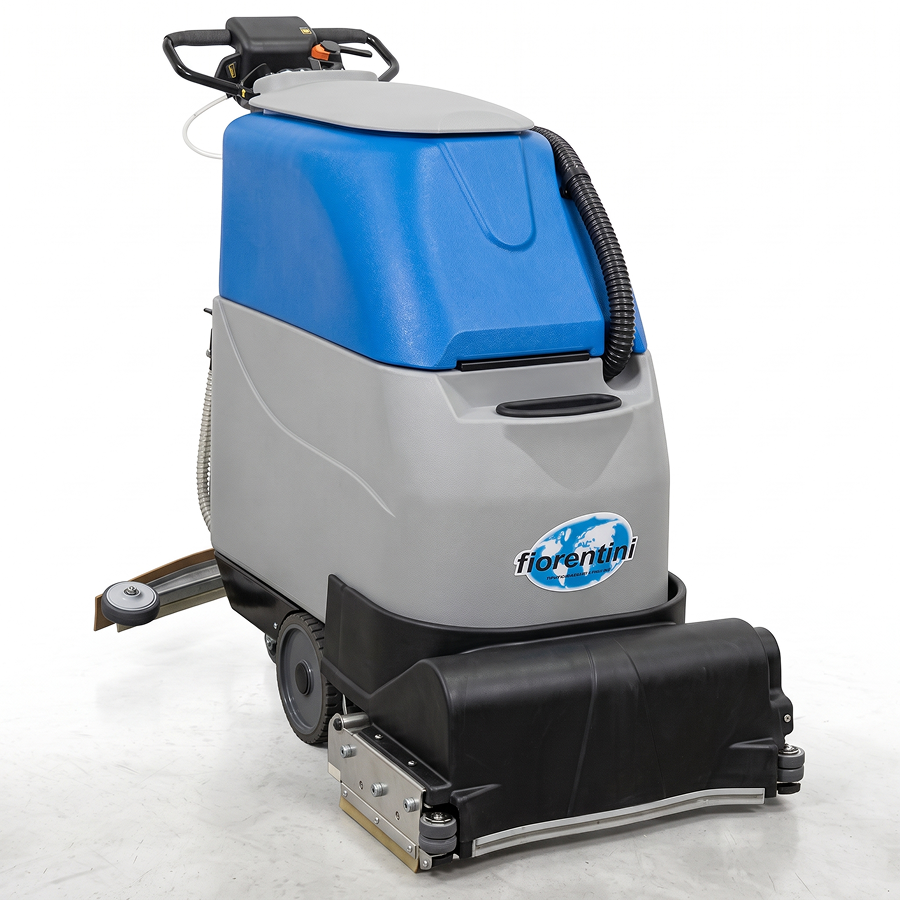
Available for purchase right now.
The GIAMPY 22 BR is a walk-behind, battery-powered scrubber dryer featuring two cylindrical brushes with a 110 mm diameter and a 505 mm working width. Counter-rotating action sweeps solid debris directly into an integrated stainless steel hopper. This model is optimal where comprehensive scrubbing of profiled floors is required in confined spaces.
Technical Specifications:
- 2,300 m²/h theoretical productivity
- 505 mm brush scrubbing width
- 50 / 50 L solution and recovery tank capacities
- 24 V operating voltage
Traction drive and reverse gear simplify maneuverability. The steel chassis features an anti-corrosion coating. Brushes and protective housing can be removed without tools; squeegee blades are equally easy to replace. Daily access to the scrub deck is vital for operators: brushes require frequent inspection, removal of wound fibers, and rinsing. When routine servicing is tool-free and quick, operators can maintain peak machine condition and consistent cleaning results.
The GIAMPY 22 BR is engineered for medium-sized facilities. In warehouses, light manufacturing workshops, or utility premises, its cylindrical brushes clean uneven and textured floors while sweeping loose debris into the hopper simultaneously. Machine selection should factor in aisle dimensions alongside floor characteristics.
According to Fiorentini Russia data, the productivity rating of the GIAMPY 22 BR reaches 2,300 m²/h. When planning work schedules, operators should account for turnarounds, tank emptying/refilling, and routine maintenance downtime.
UNICA 85 R and ET 75 R: Different Brushes for Different Tasks
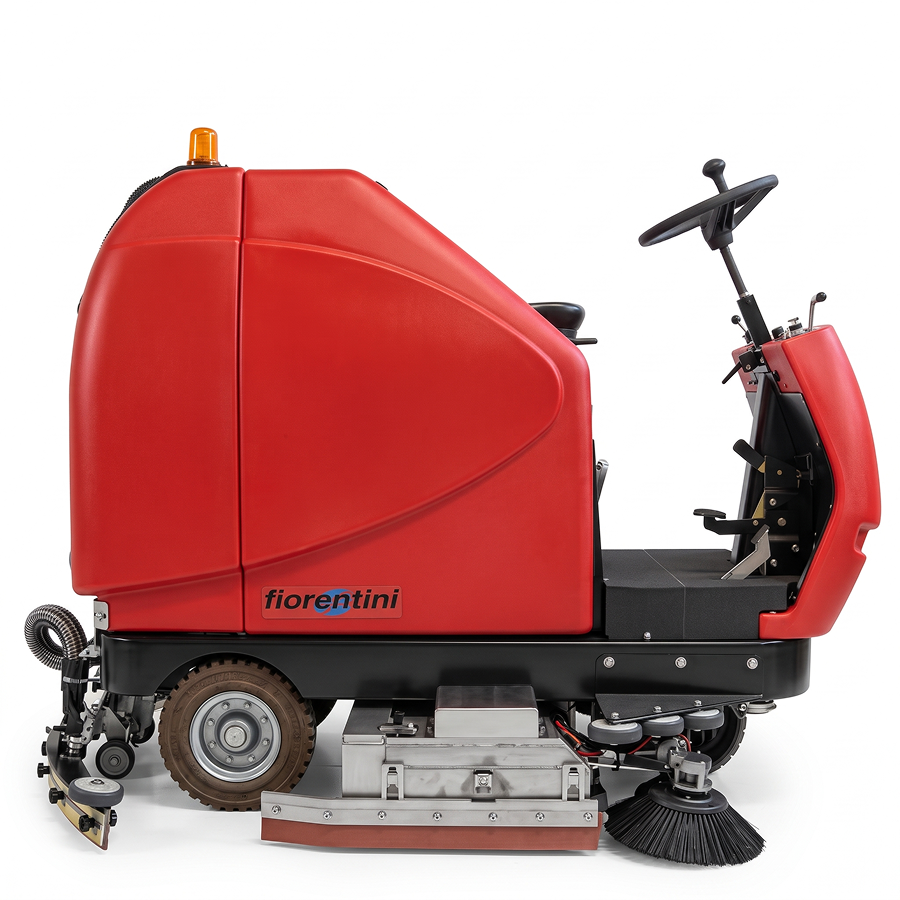
UNICA 85 R — for large areas with profiled floors. Two cylindrical brushes measuring 170 × 850 mm, a fine debris tray, and dual 225 L tanks are integrated into a ride-on platform. Working width is 850 mm, with productivity rated up to 5,950 m²/h. Large-capacity tanks reduce downtime for refilling and dumping, while powered deck lift and automatic squeegee retraction in reverse streamline operator tasks.
ET 75 R — for maintenance scrubbing on smooth floors. Dual 385 mm disc brushes, a 750 mm scrubbing width, and 125 L tanks deliver productivity up to 4,500 m²/h. It supports brushes of various stiffness ratings and pad drivers. On even surfaces, disc scrubbers deliver an extensive cleaning path. If loose debris has already been cleared and the objective is routine washing, a cylindrical system may not provide a distinct advantage.
 |
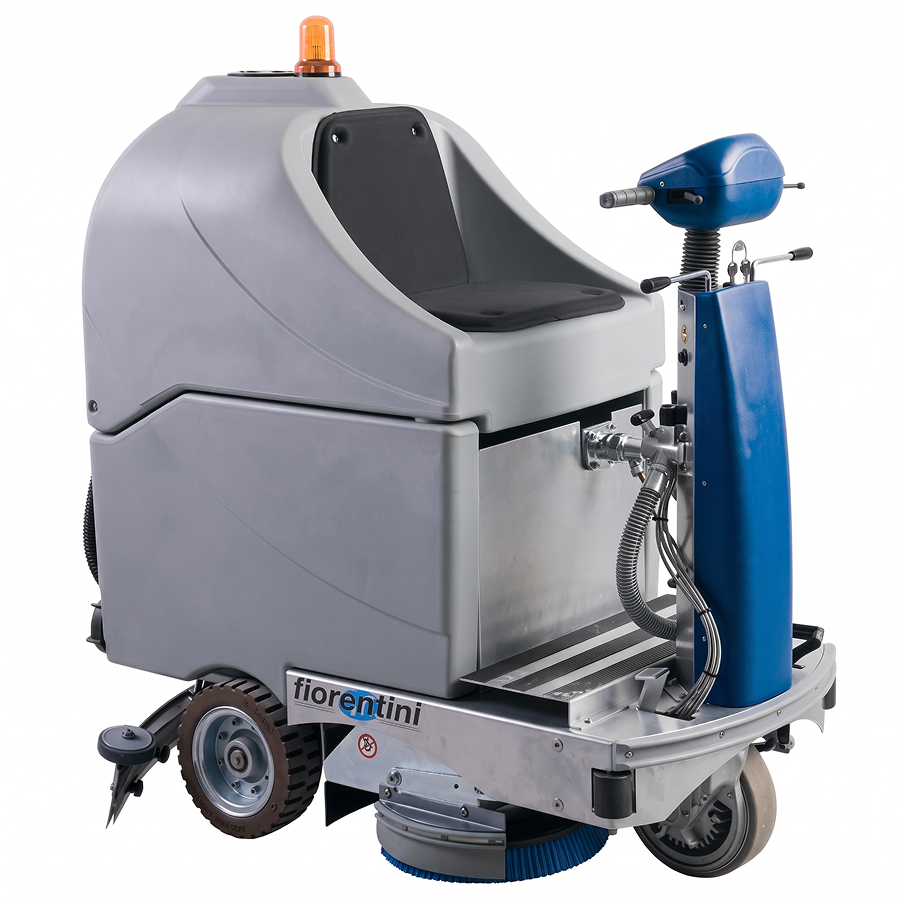 |
The GIAMPY 22 BR, UNICA 85 R, and ET 75 R occupy different machine size classes. Productivity differences between them reflect machine scale rather than a controlled comparison of cylindrical versus disc scrubbing performance.
From Operating Conditions to Machine Selection
Brush engineering, filament properties, and machine capabilities must align with the exact application. First, evaluate floor type and soil profile; next, choose the appropriate brush deck; finally, reconcile machine productivity and footprint with overall facility dimensions and cleaning timeframes.
|
Application |
Recommended Fiorentini Solution |
|---|---|
|
Compact scrubber for structured floors |
GIAMPY 22 BR with cylindrical brushes. Available for purchase |
|
Large areas, profiled surfaces, and fine debris |
UNICA 85 R: cylindrical brushes and integrated debris tray |
|
Routine scrubbing on smooth floors |
ET 75 R with suitable-grit disc brushes |
|
Specialized requirements for aggressive scrubbing |
Selection of brushes or floor pads tailored to the surface and chosen model |
Equipment Maintenance
Routine maintenance requires untangling fibers from the brushes, rinsing the debris hopper, and monitoring squeegee condition. Worn or fouled bristles degrade floor contact; an improperly maintained recovery assembly leaves residual water even after thorough mechanical scrubbing. Consistent cleaning results depend on all these assemblies working seamlessly together.
Cylindrical brushes excel on profiled floors and in scenarios where scrubbing is best combined with debris collection. Disc brushes retain their clear advantages on flat surfaces. Fiorentini offers both systems, allowing the real value of the machine to show in daily operations: through cleaning performance, straightforward servicing, and low total cost of ownership.
Fiorentini: Engineering Built to Last
Behind the Italian heritage of the brand lies proprietary manufacturing and decades of engineering practice. Engineering expertise is refined through real-world operation: diverse surfaces, soils, and operating regimes highlight which design solutions deliver lasting performance.
Compared to budget alternatives, Fiorentini stands out through material selection, precision manufacturing, robust corrosion protection, and heavy-duty industrial ratings. Long-term reliability is governed by engineering quality and operational discipline, not merely country of origin.
Over the long haul, premium build quality is offset by extended service life and consistent cleaning performance. Regular shipments to Russia continue uninterrupted, with machines and genuine spare parts kept in stock. Dedicated domestic support reinforces the brand's primary advantage: proprietary engineering heritage and professional-grade machinery.