
Magnetic plates: types, GOST, application, main manufacturers
Magnetic plates is a type of machine tool that is used on metal—cutting machines to fix workpieces made of ferromagnetic materials during processing by cutting or grinding a tool. tool.
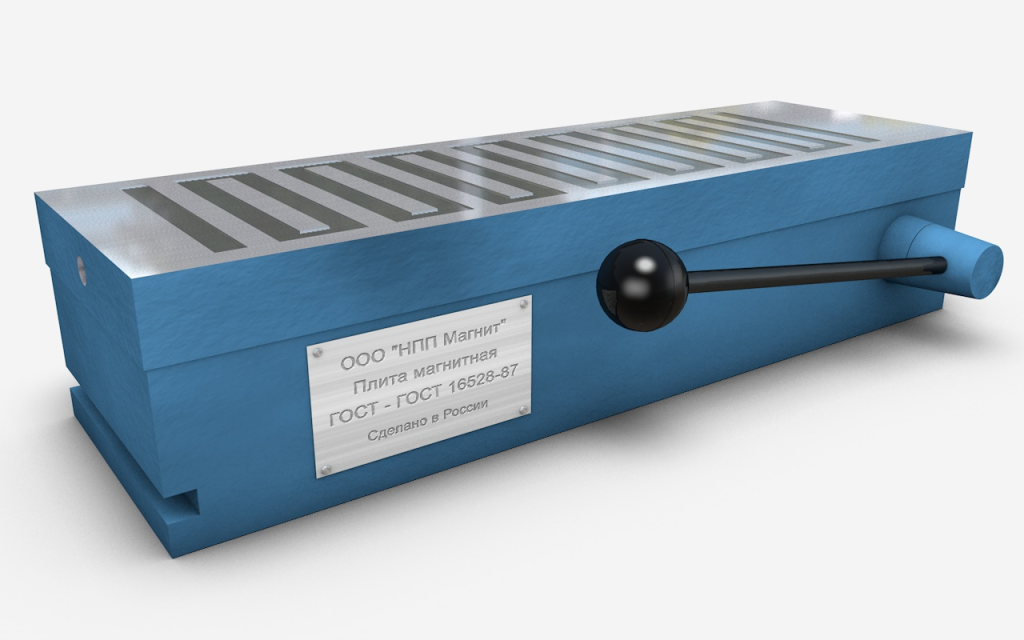
The workpieces are fixed on the plate by a magnetic field, without mechanical action, which eliminates damage to the part. Magnetic plates are manufactured according to GOST 16528-87, there are accuracy classes H, P, B, A, C, with manual or remote control.
Types of magnetic plates
According to the principle of creating a powerful magnetic field, all plates are divided into two types:
-
mechanical, simply referred to as magnetic plates;
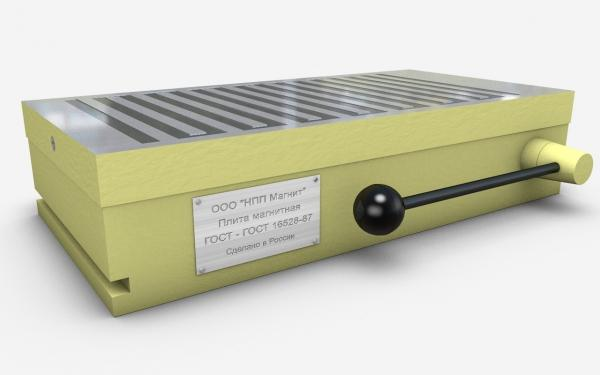
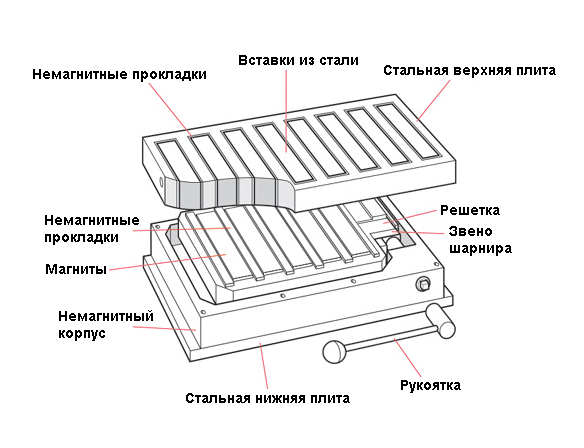
The magnetic mechanical plate is represented by a set of permanent magnets arranged in such a way that the clamping of the part is created by a magnetic field. In the switched-on state, its power lines pass through the poles of the magnets, the steel inserts of the upper part and the body of the fixed workpiece. Turning off such a plate is performed by shifting the matrix with permanent magnets relative to the steel magnetic circuits, as a result, the magnetic flux through the workpiece sharply weakens, freeing the part. The movement of the block with magnets is controlled by an eccentric mechanism driven by an outward-facing handle.
The main advantages of a mechanical magnetic plate are:
- full energy independence, switching on/off is performed due to muscular energy;
- durability, determined by reliable fixation throughout the entire service life;
- no need for maintenance and repairs, as well as the cost of them.
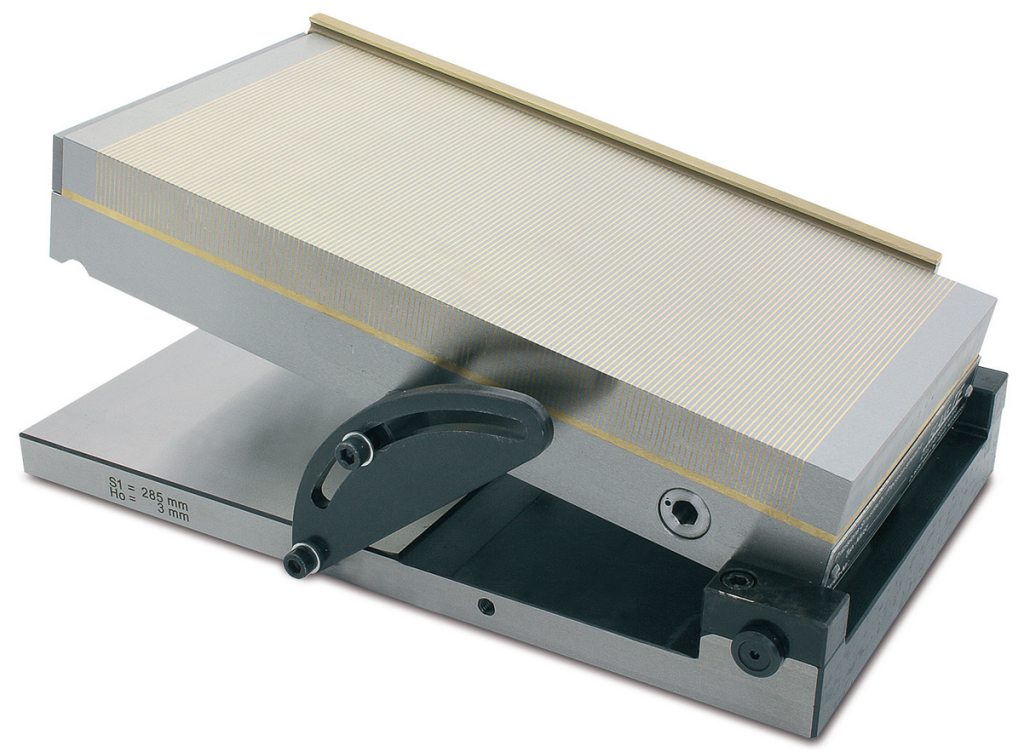
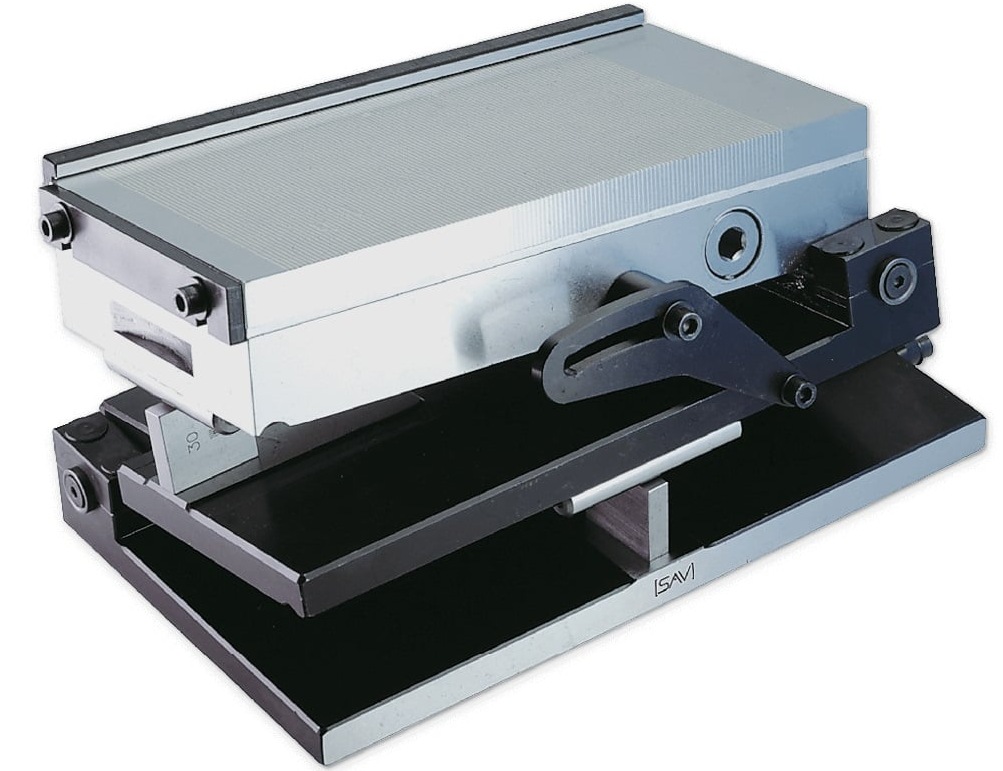
One of the varieties of a mechanical magnetic plate are the so-called sine plates, which ensure the position of the workpiece at an angle to the plane of the table. There are single-turn and double-turn sine plates. Single-rotations allow the part to tilt along one axis, double-rotations, respectively, on both.
-
electromagnetic, in which the magnetic field is created by electric magnets.
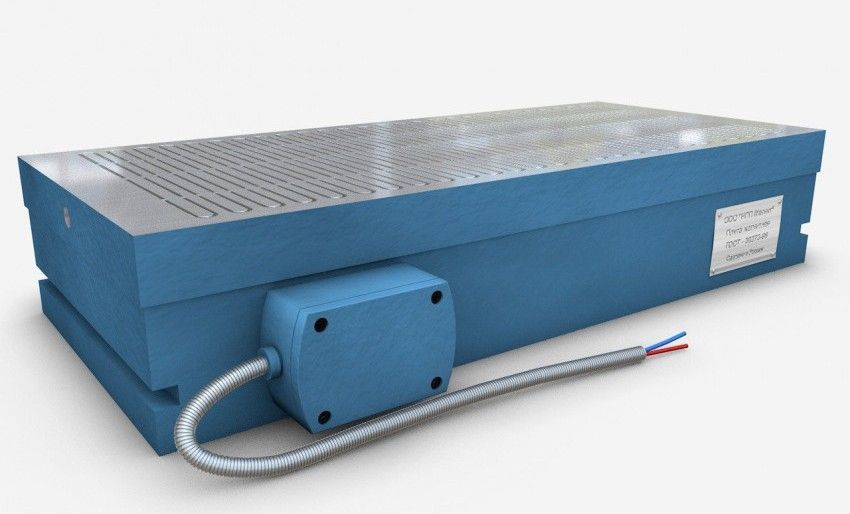
An alternative to the mechanical, electromagnetic plate of machine tools instead of permanent magnets is represented by electromagnets powered by an external power source. There is a distinction between ordinary ones with a standard distance between the poles and small-pole ones with shortened interpolar spaces. The latter are widely used in machines that process small parts.
The advantages of an electromagnetic plate are considered to be:
- possibility of remote control via controllers and remotes;
- downforce adjustment;
- the presence of a demagnetization mode (removal of residual magnetization).
However, there is one significant drawback – in the event of a power failure, the workpiece is torn off the work surface.
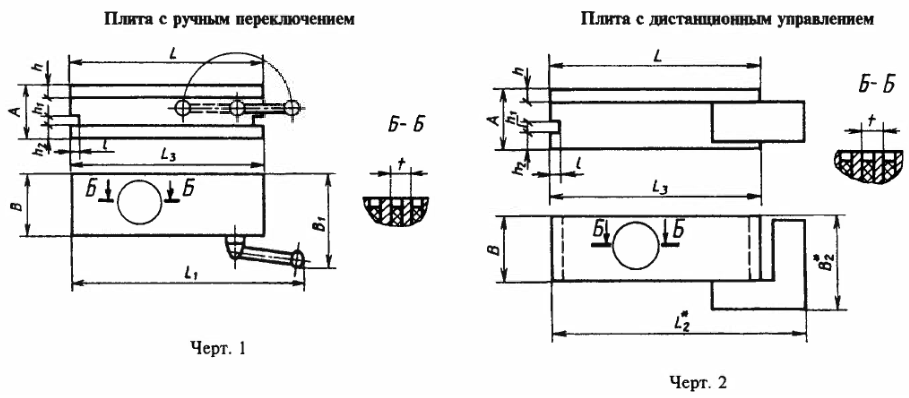
Magnetic plate design with manual switching
The principle of operation of the magnetic plate
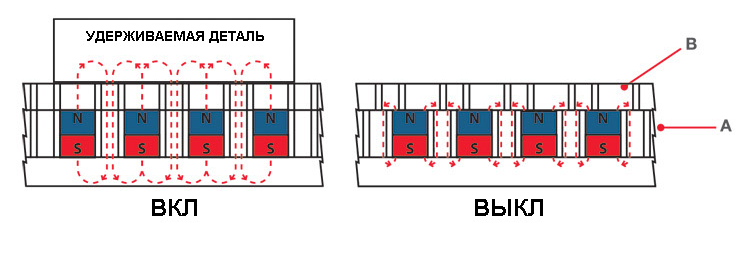
The plate is switched on and off by moving the central magnetic assembly A. When the magnets are aligned with the steel plates on the upper plate B, the magnetic forces are directed at the fixed part. When the magnetic assembly is shifted relative to the plate, the magnets "lock" onto each other, and the attraction of the part does not occur.
Basic dimensions of magnetic plates according to GOST16528-87
Other types of magnetic plates
Single-turn sinus plates
The pivoting parts of the single-turn plate operate in the longitudinal plane
Two-turn sinus plates
The rotating parts of the two-turn plate operate in the longitudinal and transverse planes
Rectangular reinforced plates (PMSPU)
In terms of gravity, this type of product significantly exceeds the "ordinary" GOST plates. The specific gravity is at least 180 N/cm2.>. The remaining characteristics (except for weight) comply with GOST 16528-87.
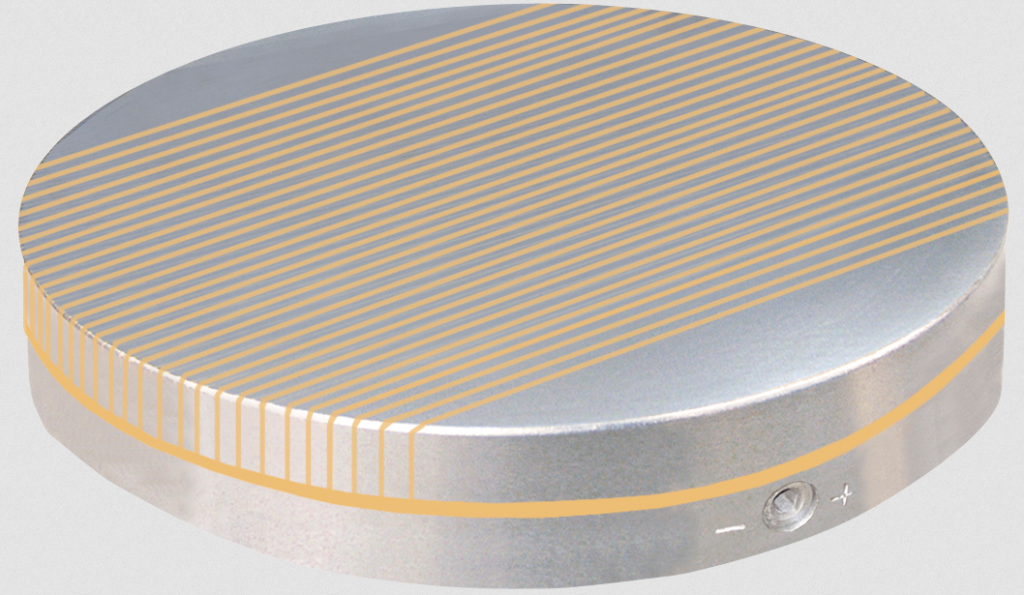
Round plates
For round worktable machines
Application of magnetic plates
It is advisable to use magnetic plates when you need to fix a small part. An important advantage of this fastening method is the accuracy of installation during the entire processing period of the product. As a rule, magnetic plates of various types are not included in the basic equipment of the machines and they have to be purchased separately. The main parameters to consider when choosing are:
- overall dimensions, they must be taken into account when choosing;
- the mass of the plate is an important parameter dictated by the capabilities of the machine table;
- the clamping force required to perform the intended operations;
- the distance between the poles of permanent magnets or electromagnets;
- the type of equipment.
Choosing a magnetic plate based on the above parameters allows you to choose the best option for specific machines.

Manufacturers of Magnetic Plates
- NPP Magnit LLC one of the leading Russian manufacturers of magnetic and electromagnetic rectangular plates and electromagnetic round plates for machining ferromagnetic parts (workpieces) on grinding, milling and other metalworking machines.
- Company IRVEL-prom, has been producing and selling electromagnetic plates for grinding machines for 11 years at affordable prices with a guarantee manufacturer's qualities.ities.
- Nromservice-M
Since 2012, he has successfully established mass production and manufacture of magnetic, electromagnetic, sine, small-pole, round plates of all sizes and modifications.
- Magnitar LLC is one of the leading manufacturers of lifting magnetic grippers in the Russian Federation.ration
- Lipetsk Machine Tool Company - a specialized company for the production of electromagnetic plates. Manufactures and sells a full range of electromagnetic and magnetic plates, magnetic cartridges, lifting and lifting devices, magnetic plates for bending machines, annular electromagnets for cleaning pipes for the oil and gas industry and other similar devices.
- Pokrovsky Machine Tool Plant is a manufacturing company specializing in the repair of metalworking equipment and the supply of spare parts and equipment for machine tools.
Sources
-
GOST 16528-87
Очень информативная статья! Спасибо автору!
Васильев Артём, согласна) актуально и по делу
Спасибо за ссылки на ГОСТы в статье - удобно! Сохранил себе)