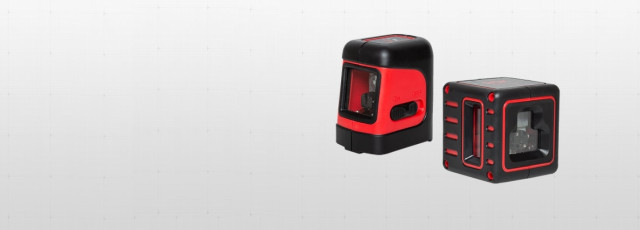
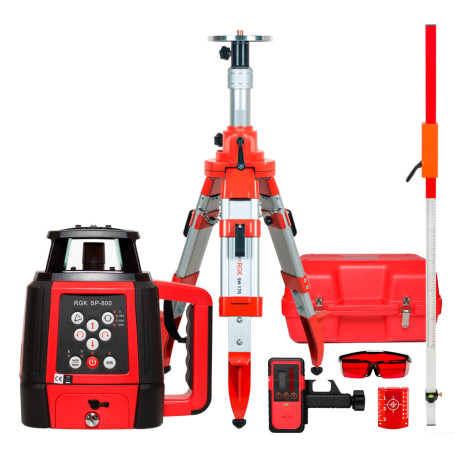
Set: RGK SP-800 rotary leveler + rack tripod


 Russia
 China
China

Description
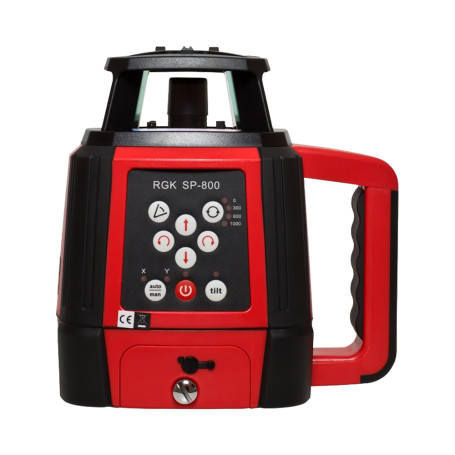
The RGK SP-800 professional rotary leveler is the best choice for leveling in open areas, as this tool has the maximum beam power in the class, so that the range of operation can reach 400 meters! To work at such long distances, the RGK SP-800 level set must use a special RD laser radiation receiver included in the device package.
The RGK SP-800 rotary level belongs to the class of self-leveling levels, that is, when turned on, it automatically sets the horizontal plane after a couple of seconds. Forget about the long and painstaking level setting, now just press one button and get to work immediately. The electronic compensation system ensures fast and accurate level alignment in the horizontal and vertical planes. The alarm function during the clearance will not allow the production of erroneous markings.
RGK SP-800 laser level + RGK SH-170 tripod allows you to build up a horizontal and vertical plane in space by 360°, as well as design a zenith point, for quick transfer of a point from the floor to the ceiling. Depending on the type of work, the user can manually set the rotation speed of the laser head in four modes – 100, 300, 600 revolutions per second, as well as completely disable rotation for projecting a single beam.
Advantages:
- Included with the RGK SP-800 rotary level, along with the laser radiation receiver, there is a remote control that allows you to control the level from a distance.
- To install the level on a professional tripod, a 5/8 thread is provided, which also allows it to be fixed on a spacer rod or on a stop.
- The shock-resistant rubberized housing provides reliable protection against dust, moisture, temperature fluctuations and vibrations.
- The manual adjustment function allows you to turn off the compensator and set the laser level to the required horizontal or vertical position for projecting inclined planes.
RGK SH-170 Tripod
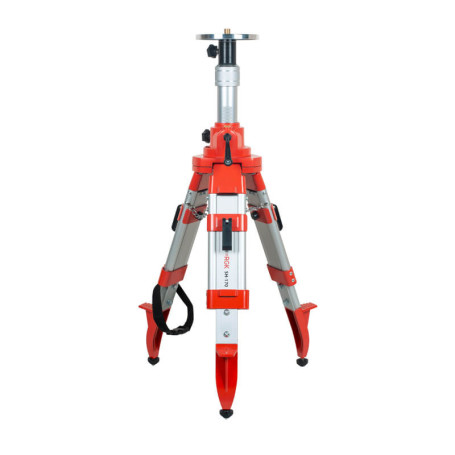
The RGK SH-170 tripod for laser levels is a stable and durable elevator-type accessory, with which you can smoothly and accurately change the height of the installation of devices in the range from 0.69 to 1.7 m. The lifting platform is equipped with a 5/8" thread, which is compatible with most models of rotary levellers and plane builders.
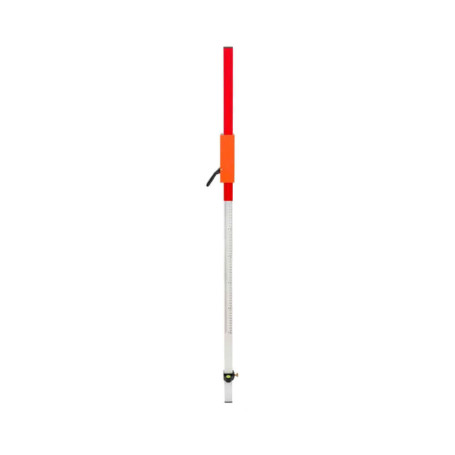
Leveling rail RGK LR-2
It is designed for use with any type of laser levels and serves for smooth movement of the radiation receiver along the vertical axis. This tool makes it easier to work over long distances and in bright sunlight.
Design features
The telescopic racks are equipped with clip-on clips, so that the preparation of the geodetic tripod for operation takes a few seconds. Special chains limit the movement of the legs within safe limits, and anti-slip pads and strong stops help to securely install the tripod on parquet, ground or asphalt.
High quality
High-quality assembly and aluminum housing make this model an excellent choice for outdoor work. The lifting mechanism is made of metal and has a clear, understandable stroke. The length of the folded tripod is only 70 cm, which, together with a convenient strap for fixing the legs, greatly simplifies transportation.
Technical Specifications:
RGK SP-800
- The number of horizontal planes is 1.
- The horizontal scan angle is 360°.
- The number of vertical planes is 1.
- The accuracy is ± 0.5 mm per 10 m.
- The range of operation with the receiver is up to 400 m.
- The color of the laser beam is red.
- The type of compensator is a servo drive.
- Automatic leveling system (compensator operating range) - ± 5°.
- Construction of inclined lines.
- Mounting on a tripod.
- The batteries are Ni-MH battery.
- Battery life is up to 25 hours.
- The laser class is 2.
- The wavelength is 650 nm.
- The power is < 1 MW.
- The indication is audible/visual (light).
- The degree of protection against dust and moisture is IPX54.
- The operating temperature range is -20° to +50°C.
- The storage temperature is -20° to +50°C.
RGK SH-170
- Application - for rotary levelers.
- The material is aluminum.
- Height - from 0.69 to 1.7 m.
- The threaded connection is 5/8".
- Clips are clips.
RGK LR-2
- The purpose is for laser levelling.
- Height - up to 2.4 m.
- The millimeter scale.
Equipment:
- RGK SP-800 laser level.
- RGK SH-170 elevator tripod.
- The leveling rail RGK LR-2.
- A laser radiation receiver.
- The remote control.
- Laser glasses.
- Target.
- Bracing.
- The charger.
- A car charger.
- Batteries - 2 pcs.
- A slot for batteries.
- Case.
- Instruction manual.
Characteristics
General Specifications
China
Russia
Specifications
This parameter shows how many laser lines or dots the device can project at the same time. The more beams there are, the less you have to move the level to mark the room.
-
1-2 rays: Classic "cross" (vertical and horizontal). It is ideal for everyday tasks: to hang a shelf, a painting or to paste wallpaper.
- 3-5 beams: Allow additional marking of plumb points (floor/ceiling) and right angles. It is convenient for installation of partitions. 8-12 rays (3D): Project closed 360° lines on all axes. They allow you to work in the entire room at once, they are indispensable when filling the floor and installing stretch ceilings.
- 16 beams (4D): Maximum configuration with two horizontal planes (top and bottom). The lower beam runs as close to the floor as possible, which is convenient for laying tiles.
This parameter shows how many laser lines or dots the device can project at the same time. The more beams there are, the less you have to move the level to mark the room.
-
1-2 rays: Classic "cross" (vertical and horizontal). It is ideal for everyday tasks: to hang a shelf, a painting or to paste wallpaper.
- 3-5 beams: Allow additional marking of plumb points (floor/ceiling) and right angles. It is convenient for installation of partitions. 8-12 rays (3D): Project closed 360° lines on all axes. They allow you to work in the entire room at once, they are indispensable when filling the floor and installing stretch ceilings.
- 16 beams (4D): Maximum configuration with two horizontal planes (top and bottom). The lower beam runs as close to the floor as possible, which is convenient for laying tiles.
- Vertical / Horizontal: The basic option for simple tasks (mounting shelves, leveling paintings).
- Scan angle (e.g. 100° or 240°): Indicates the length of the line. The larger the angle, the less you need to rearrange the device to capture adjacent walls.
- 360° (circular marking): The line runs around the entire perimeter of the room. This allows you to work in the entire room at once without turning the level. Ideal for stretch ceilings and floor screeds.
- Points (up/down/ forward/sides): Called a "plumb line". They are used to transfer labels from the floor to the ceiling (for example, when installing lamps) or to quickly arrange partitions at right angles.
- Vertical / Horizontal: The basic option for simple tasks (mounting shelves, leveling paintings).
- Scan angle (e.g. 100° or 240°): Indicates the length of the line. The larger the angle, the less you need to rearrange the device to capture adjacent walls.
- 360° (circular marking): The line runs around the entire perimeter of the room. This allows you to work in the entire room at once without turning the level. Ideal for stretch ceilings and floor screeds.
- Points (up/down/ forward/sides): Called a "plumb line". They are used to transfer labels from the floor to the ceiling (for example, when installing lamps) or to quickly arrange partitions at right angles.
Additional characteristics
Terms of delivery
Who provides the delivery of goods?
On the Enex marketplace, you order the product directly from its supplier, and Enex employees organize the delivery in the way you choose.What are the delivery methods?
You can choose any convenient way for you to receive an order:-
Pickup from partner locations or from the manufacturer's warehouse
If the manufacturer or trading company has the possibility of pickup, you can pick up your goods yourself or use the services of any transport company. Pickup is free of charge. -
Delivery to the terminal by a transport company
Pick up the goods at the nearest terminal of the Business Lines shopping center or DHL in your city. The delivery time and cost depend on your region and the dimensions of the cargo - they will be known at the stage of ordering. -
Delivery to the door by courier of the transport company
Receive the goods at your address via a Business Lines courier or DHL. The delivery time and cost depend on the region and the dimensions of the cargo - they will be known at the stage of ordering.
How can I keep track of the shipped product?
After you have selected your preferred delivery method and placed an order, you will be able to monitor the change in its status by the number in your personal account, and track the immediate location of the product by the track assigned by the delivery service. You will also receive email notifications about changes in the status of your order. This way, you will always know where your product is located and respond promptly to changes.Payment methods
Payment by bank card online
You can pay for the goods with bank cards "Visa", "Master Card", "Mir", "JCB". Payment by bank card is made without commission.- your bank card number;
- expiration date of your bank card;
- CVV code for Visa / CVC code for Master Card: the last 3 digits on the signature strip on the back of the card;
- confirm the card transaction, for example, with a one-time password from an SMS.
Payment according to the invoice
On the checkout page, select the “Invoice payment” option, and after placing the order, the system will automatically generate and send you an invoice for payment to the specified email address.Payment with bonuses
The buyer can pay part of the order cost (up to 20%) with Enex bonuses. The procedure and conditions for calculating and debiting bonuses are specified in section 7 Rules of sale and delivery.The seller's indication on the marketplace
Various suppliers of tools and equipment trade on the Enex marketplace. These can be both manufacturers and trading companies. In this case, the Marketplace acts as an agent (Chapter 52 of the Civil Code of the Russian Federation). Enex itself can also act as a seller for some products. Learn more about ordering from different suppliers.Return of goods
Is it possible to return the purchased product?
If you are not satisfied with the product purchased on the Enex platform, you can return it or exchange it under the conditions specified below. Since buyers conclude direct purchase and sale transactions with manufacturers on the Enex platform, the return of goods is carried out directly to manufacturers.
Return of goods of proper quality
For individuals
The buyer-an individual has the right to refuse the ordered goods at any time before receiving it, as well as after receiving the goods - within 7 days, not counting the day of purchase. The return of the goods is possible if its presentation and consumer properties are preserved, as well as a document confirming the fact and conditions of purchase of the goods.
The buyer does not have the right to refuse a product of proper quality having individually defined properties if the specified product can be used exclusively by the buyer acquiring it.
In case of refusal of the goods of proper quality, the cost of services for the organization of delivery to the buyer is not refunded. Transportation costs for the return of goods of proper quality are borne by the buyer. The method of returning the goods is determined by the buyer.
For legal entities
The return (exchange) of goods of proper quality by the buyer, who is a legal entity (individual entrepreneur), is not allowed, unless otherwise provided by the agreement with the supplier.
Return of goods of inadequate quality
For individuals
The buyer, who is an individual, in cases provided for by law, may return the goods of inadequate quality during the warranty period for the goods and demand a refund of the amount of money paid for the goods. The goods of inadequate quality, in agreement with the buyer, can be replaced with a similar product of proper quality.
For legal entities
The buyer, who is a legal entity (individual entrepreneur), in the event of the transfer of Goods of inadequate quality to him, has the right to make claims provided for in Article 475 of the Civil Code of the Russian Federation.
Distribution of responsibility
In case of return/replacement of low-quality goods, the cost of delivery of the goods is paid by the supplier. The supplier reserves the right to accept the goods of inadequate quality from the buyer and, if necessary, to check the quality of the goods. If, as a result of the examination of the goods, it is established that its shortcomings arose due to circumstances for which the supplier is not responsible, the buyer is obliged to reimburse the supplier for the costs of conducting the examination, as well as the costs associated with its storage and transportation of the goods.
If any defect is found in the product, the manufacturer and (or) the marketplace has the right to require the buyer to provide a photo of the product, the claimed defect, packaging, labeling (nameplate) of the manufacturer.
If the buyer, who is a legal entity (individual entrepreneur), refuses the goods of inadequate quality, such buyer is obliged to return such goods to the supplier. The buyer - an individual can also return the goods to the address of the supplier or Marketplace.
Transportation costs for the return of low-quality goods are borne by the supplier or Marketplace.
The difference between the shades of the goods in the photo and the real goods is not a sign of poor quality.
For questions about the return or exchange of goods, please contact us by phone 8 800 707-56-00 or by email: info@enex.market .