
Device and purpose
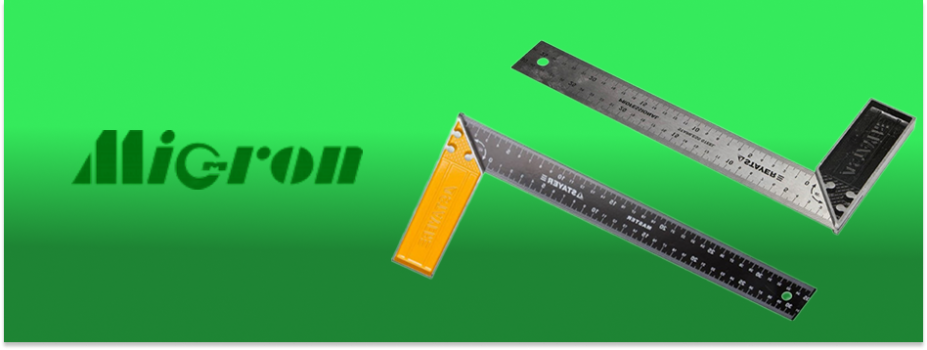
A square is a measuring instrument whose appearance resembles a ruler doubled at right angles. The main task is drawing and checking perpendicular straight lines. The simple design and ease of use are the advantages of the measuring instrument.
The corners are suitable for various tasks of repair, construction, manufacture of wooden and metal products. This tool is also used to check structures for defects, it is called a calibration square.
Despite the simplicity of the device, there are basic rules and features of using the tool:
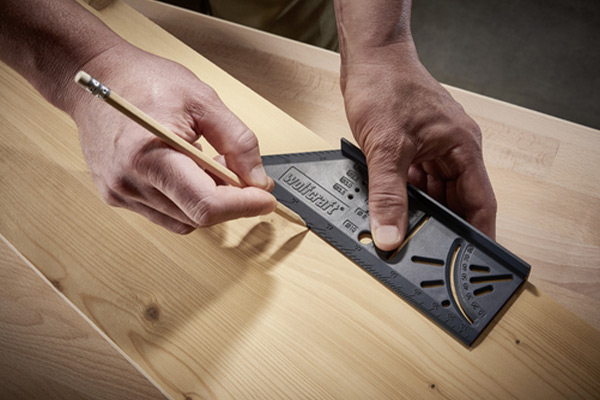
- Drawing a perpendicular. To cut the material evenly, you need to attach the product at a right angle and draw a line.
- Reading and drawing angles. When measuring, it is necessary to take a right angle as a reference point, and then find the desired mark and mark it with a marker or pencil. By combining a right angle and a marker, you will get the desired angle.
- Use as a ruler. The square is placed on the surface with a smooth side and the risk is applied with a pencil at the desired mark.
The tool is intuitive. The square is applied to any plane, and then a perpendicular is drawn. By applying the tool with the end part to two perpendicular surfaces, you can check whether the markings match the designation on the corner.
|
Materials of manufacture
Plastic, carbon steel and wood are the main raw materials from which modern measuring instruments are made. Metal corners are the most reliable option, which is not subject to deformation when falling from a small height. It is recommended to use devices made of these resistant and high-quality materials for production and construction .
There are three classes of gable accuracy:
- The most accurate zero class. Products are used in metrology, and corners of this class are also used to find errors in the finished product;
- The corners of the first class. They are used in production and workshops by builders, locksmiths, carpenters, as well as welders and bricklayers;
- The second class is suitable for household needs and interior repair work.
The length of the guide rails varies from 60 to 1600 millimeters. Depending on the model and the purpose of the angle, the scales are applied to one or both guides. Carbon steels are used for the production of corners. At the production stage, the workpiece undergoes heat treatment.
|
Types of angles
Measuring angles are divided into several types:
- verification reports;
- drawing rooms;
- carpentry;
- construction is a general category that includes corners of other types.
Having a common design, the corners differ in material, applications, dimensions, and the size of the fixed angle. The main features of each type are described below.
Drafting
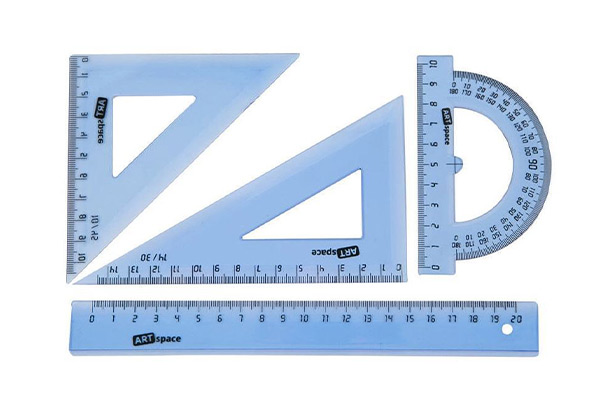
This type is characterized by its light weight and compact size. The drawing angles have the appearance of a triangle, familiar from school supplies. The tool allows you to quickly build "popular" corners. The measuring device allows you to measure the desired angle and apply perpendicular lines to the paper.
When choosing, keep in mind that the corners for the drawing differ in the type of corners:
- 45°, 45° and 90°;
- 30°, 60° and 90°.
The first type looks like a right-angled triangle. The drawing angles are used together with the protractor and are included in one stationery set, they can also be purchased separately.
Drawing tools are made of plastic or wood, less often steel. They can be used as a simple ruler, but the length of the sides of this type of square rarely exceeds 15 centimeters.
|
Verification
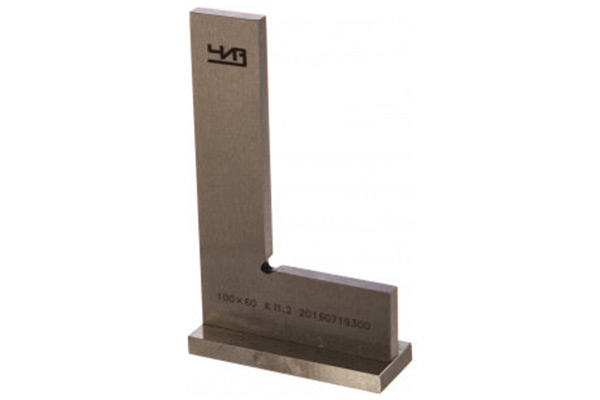
This is a professional tool that allows you to check the perpendicular. The calibration square is also used for assembling parts. The base of the tool is two rulers connected at an angle of 90°. The long part is called "H" and the short part is called "L".
All calibration tools are made of steel, so this material allows you to achieve the highest accuracy in measurements. It is worth recommending such a device if it is necessary to perform accurate measurements and draw up official documentation with a reference to the measuring instrument.
There are several types of calibration angles that differ in design. In abbreviated terms, "Y" is a corner, the following letters describe the purpose of the product:
- The STREET is a regular square. When assembling high-precision structures and in metalworking, such a square is used as a control tool.
- SFM is a regular flat square. Both shelves are made in the same plane, so the smaller part does not rest against the workpiece or the wall. Marking up and working with large details helps SFM here.
- This is a flat view of the corners, which is a monolithic angle made of steel.
- The ULC is cylindrical. The main field of application is metrology. The tool looks like a cylinder with ends that form 90° angles with the side plane.
- The ear has a broad base. The tool can be placed vertically, and an additional shelf prevents the square from tipping over.
There are strict technical requirements for these test products. GOST takes into account the degree of heat treatment and the list of steel grades from which corners can be made. The hardness of the products is 50-58 Rockwell units.
|
Carpentry
Perfectly right angles are an indicator of high-quality furniture and professional work, so every carpentry workshop has corners in its arsenal. Craftsmen use the following types of tools when working with wood:
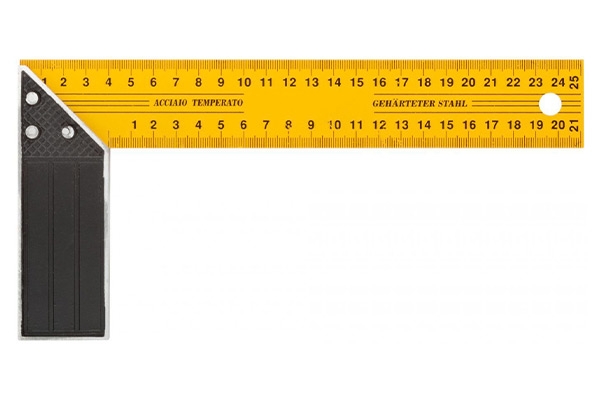
- Carpenter's square. In the design of the tool, the long side is thinner than the short side, which serves as a stop. This square allows you to measure the outer and outer corners, as well as quickly draw perpendicular lines along with straight lines.
- Marking. The marking type differs from the usual tool by perforations made on each side of the square. A removable plastic cover is provided for additional support. The product itself is made of metal. For convenience, a protractor is installed on the inner corner of the tool, which allows you to indicate any slope. Craftsmen often use a marking square instead of a reismuth.
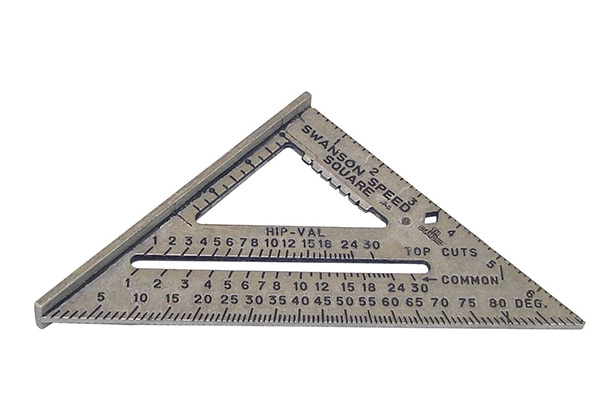
- The Svenson square. It looks like a drawing tool. The Svenson square was made for fitting and measuring elements during the installation of stairs and rafter systems. Craftsmen use it in the manufacture of doors, furniture, as well as complex window frames. The product allows you to control the plumb line, and also has a protractor and a regular ruler in its design.
When choosing a tool, it is worth giving preference to products with a large thickness of rulers. The centimeter marking should be applied from the outside and inside of the product. In addition to carpenters and carpenters, this type of square can also be recommended for household purposes if a small repair of furniture or wooden structures is planned in the house.
|
Construction
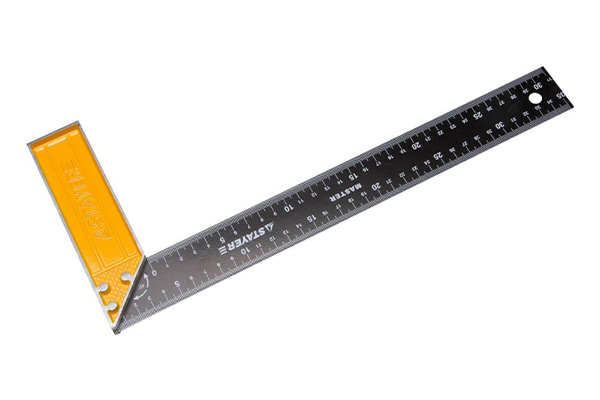
This is a general category, as different types of measuring instruments are used in construction, which were originally created for other tasks. Tilers often use a carpenter's square, so it allows you to quickly make markings, which simplifies the tile cutting process. The carpenter's square also helps in cutting floors and rafters.
Svenson's corners, which belong to locksmiths, can also often be seen in the arsenal of builders. With their help, you can easily make markings on boards, tiles, or sheets of drywall.
Only the "mason's square" was made especially for the construction. The construction square is large in size and is produced by stamping. The product allows you to check the inner and outer corners when laying bricks or other building materials. The tool is bulky and has no stop, so you should not work with such a square for minor household repairs.
|
Tips on choosing a square for work
Having dealt with the types of angles and the principle of operation of the measuring product, you can proceed to the selection. For household needs and minor exterior repairs, a square with the second accuracy class can be suitable. If you plan to purchase for an enterprise or workshop, then you should choose a first-class product.
These recommendations will help you choose the best option:
- Measuring angle. If a corner is purchased for marking out perpendiculars, then it is worth giving preference to inexpensive corners without moving parts.
- The presence of markup. The classic versions have a smooth surface. It is recommended to choose a tool with markings to use the square as a ruler.
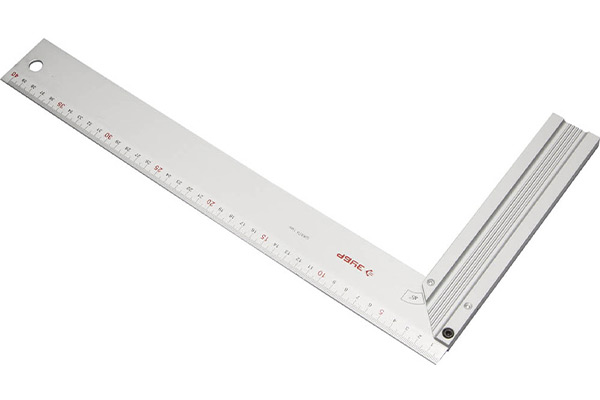
- Size. The accuracy of measurements depends on the length of the sides of the corner. A tool with a length of 15-35 centimeters is suitable for repair and finishing work. For large structures, devices with component lengths up to 6 meters are used.
- Materials. When choosing a tool for your home, you can use a plastic or wooden option. If you plan to work in a workshop or garage, then you should choose a more durable metal square product.
- Reliable fixation.The thickness of the guides should increase in proportion to their length. If the rulers are long and thin, this will lead to gross measurement errors.
|