
How to choose a generator for a private house? It is necessary to take into account several parameters that will allow you to calculate the power, determine the type of generator and choose the optimal cost.
What power should a generator have for a private house?
The generator can be useful at home in the following cases:
- The main source of energy, for example, a generator for a cottage or a country plot, when there is no connection to electricity.
- A backup generator for a home is a source of electricity in case of a power outage.
- An additional source of electricity if the available capacity of the power grid is not always sufficient. For example, in the case of connecting powerful equipment - machine tools, tools, refrigeration equipment.
The generator power for a private house is selected based on the total power of all connected devices. At the same time, it is necessary to make a margin of 30-35% to avoid overloading the system.
To calculate the power, you need to add up the energy consumption of all devices and multiply the resulting number by the starting factor. These values are usually indicated by manufacturers in the instructions for the equipment.
For example, with minimal power consumption, a 1-1. 5 kW generator is sufficient. To power the lighting and computer with 2-3 kW. If you plan to connect household appliances, you can no longer do without a generator with a capacity of 3-4 kW. And for the full-fledged maintenance of a private house, taking into account the operation of the pumping station and the maintenance of heating - from 10 kW.
|
Generator types by fuel type
The choice of a generator for a country house also depends on the type of fuel. Let's look at them in more detail.
- Gasoline generator for home. It has a low cost and an affordable fuel source. It does not require complex maintenance. It works more noisily compared to diesel and gas generators.
- A gas generator. Runs on natural gas, biogas, or propane. In terms of emissions, it is the most environmentally friendly, especially if it runs on biogas. A gas generator for a home promises a long service life, lower noise and low emissions. Before you buy a gas generator for your home, you need to familiarize yourself with the requirements for installing such a generator indoors.
- Diesel generator. It runs on diesel fuel, has high power and a long service life. A diesel generator for a home is more economical to use, as diesel fuel is usually cheaper than gasoline and gas.
- Combined generator. It provides uninterrupted power in two ways: when running on liquid fuel in offline mode and when connected to a gas cylinder.
Generator voltage
To choose a good generator for your home, you need to determine how many phases your generator will have. A single-phase generator generates electricity through a single alternating current. At any given time, all current passes through one phase, creating a unipolar voltage. A single-phase generator is usually sufficient for standard household needs.
A three-phase generator produces three separate alternating current waves. This creates three separate phases that ensure a more stable and efficient energy distribution. Such generators are usually used for industrial purposes and in production, when it is necessary to ensure the operation of large equipment, such as central air conditioners, powerful engines and tools. Thus, three-phase generators are usually more powerful and efficient, but they are more complex, heavier, and more expensive than their single-phase counterparts.
To power simple household appliances with low power, you can choose a single-phase model. It is suitable if you plan to use lighting and heating devices, a refrigerator, a kettle, an electric stove. The single-phase model will provide current with a voltage of 220 V. One of the advantages is low cost and easy maintenance. But it is worth noting that single-phase generators cannot cope with large appliances and powerful power tools, as well as air conditioners.
If you plan to connect such devices, as well as a multi-burner stove, pump, welding machine, then you need to consider a three-phase generator with a voltage of 380 V. Such generators are more efficient, but their cost is higher. It is necessary to take into account the nuances in the connection - an incorrectly distributed voltage can disable the generator.
Generator start type
If you are wondering how to choose the best generator for a private home, be sure to study the types of generators in detail. They come in several types:
- Manual starter. When you need to pull a special cable, expect resistance, pull sharply and release smoothly. This is how most diesel and gas generators are started.
- Electric start. It starts by simply pressing the button, which greatly simplifies interaction with the generator. The disadvantages are the increased cost and the rechargeable battery. As a result, it is less reliable.
- Remote control. This is an upgraded electric starter powered by a built-in battery. The generator can be started remotely using a special key fob with an antenna.
- If special requirements are imposed on the generator, there is a high importance and it is impossible to allow even a short-term disconnection of electrical appliances from electricity, you can choose a generator for a home with auto-start. The system automatically monitors the voltage in the main power grid, as soon as electricity stops coming from it, the generator takes over this function. Generators for a private home with auto-start ensure reliable supply, making life much easier for the owners.
Which generator should I buy for a private house? The choice between synchronous and asynchronous generator
Synchronous generators provide a more stable voltage and are suitable for powering devices such as computer equipment and sensitive medical devices. They are highly efficient when working with a variable load. At the same time, synchronous generators are not able to cope with peak voltage and power surges that can occur when power tools, pumps, refrigerators, and air conditioners are turned on.
Asynchronous generators are easier to maintain and cheaper, but they can have voltage fluctuations, making them less suitable for certain types of loads. Asynchronous generators easily tolerate short-term triple overloads during startup. They are suitable for use as a backup power source.
Thus, synchronous generators are better suited for situations where stable voltage and operation with sensitive devices are important, while asynchronous generators are better suited for general use with devices that are not sensitive to the quality of electricity.
|
Continuous operation time of the generator and tank volume
Before you buy a generator for a cottage, get advice on the volume of the fuel tank. Its volume depends on the power of the generator for the home, the efficiency and battery life of the device.
Some options and their characteristics:
- Volume is up to 10 liters. The continuous operation time of the generator at this volume is 4-8 hours, which covers the usual household needs.
- The volume is from 10 to 35 liters. It is suitable for medium-power generators in high-load conditions. At the same time, the generator is capable of operating without refueling for up to 14 hours.
- The volume is over 35 liters. Designed for high-power models. They are more often used at vital and large construction sites, in emergency situations, in remote and hard-to-reach places. Less often in private and home use.
Noise level of the generator
The optimal noise level for generators in residential areas is considered to be in the range of 50-60 dB. This is the usual noise level that we are used to in public places.
The noise level depends on the type of generator and other factors:
- Gasoline generators are quieter due to the design features of the engine. The average noise level is about 64 dB.
- Diesel generators for the home are noisier (from 70 dB and above), but they are more efficient and more durable for long-term operation.
- The noise level of gas generators is up to 75 dB, which can be compared with a working vacuum cleaner. Gas generators for homes are less noisy than diesel generators.
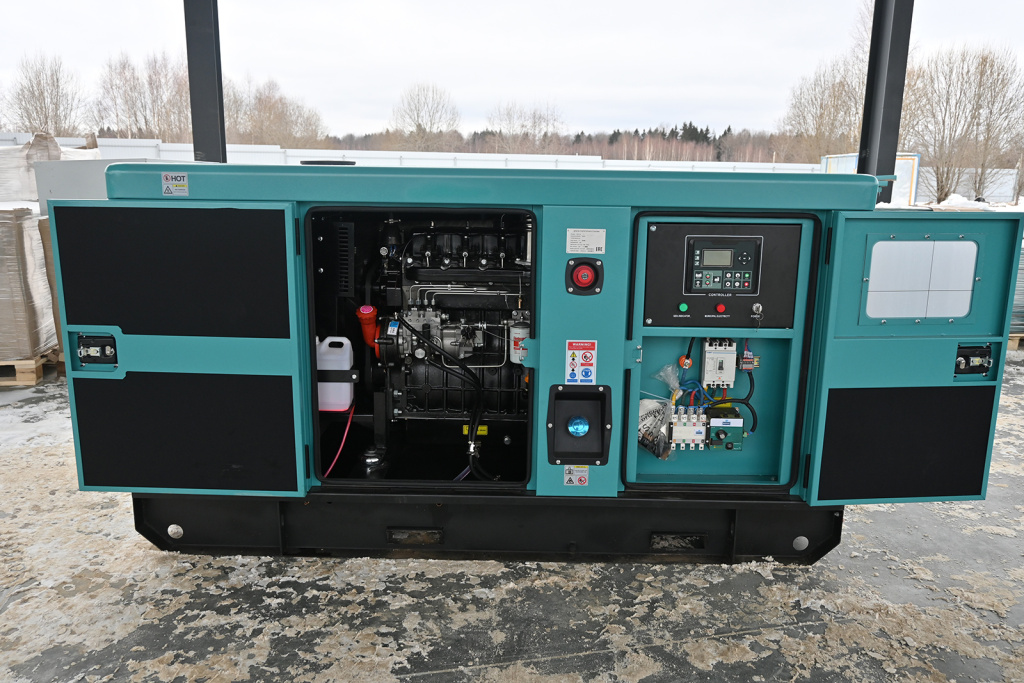
Which generator should I choose for my home? If the generator is going to be used in residential areas or requires frequent use, it is worth considering low-noise options or protecting the generator with a noise-absorbing casing so as not to violate the maximum permissible noise standards. You can buy a diesel generator for a house in a casing at the Fregat Trading House.
When planning to buy a generator for a private home, it would not be superfluous to think about protecting the generator from overloads — a function that is present in every modern device. It is necessary to prevent overheating of the wires and failure of the generator winding.
Fuses or automatic weapons act as a protection element.
The machines are based on a decoupler, a device that opens the circuit when overloaded.
Fuses are conductors in a shell that melt under the influence of high current and open the circuit. The operation is delayed in time while the conductor heats up. The greater the excess current, the faster the insert will melt.
Automatic shutdown occurs when protection is triggered. This is noticeable in a number of ways: the brightness of the lighting decreases, powered devices can barely cope with the functionality, and a decrease in the engine speed of the generator is audible.
To avoid overloading the generator, it is important to choose the right power, taking into account all potential loads, and regularly carry out maintenance, monitoring the condition of the device.
|
How much do generators cost for a home?
The price of a generator for a private house depends on many parameters - power, fuel tank capacity, type of start, and the presence of a generator casing. It is necessary to focus on trusted manufacturers with a good reputation and the availability of service centers. Having a warranty and availability of spare parts will provide peace of mind in case repairs or maintenance are needed.