

Features of Skole step drills
Construction and materials
- Material: The drills are made of high-speed steel (HSS). Often coated with titanium nitride (TiN) gold color. This coating significantly increases the hardness, wear resistance and heat resistance of the drill bit.
- Construction: The classic conical shape with well-defined steps. Each step corresponds to a specific diameter, which is marked on the body of the drill.
- Tip: The tip of the drill has a sharp centering tip for precise drilling without slipping.
- Shank: Usually hexagonal (for 1/4" bits) for secure clamping in the drill/screwdriver chuck or in the adapter without slipping.
The main advantages of Skole step drills
- Versatility: One drill bit replaces a set of regular ones. It allows drilling holes of different diameters (for example, from 4 to 32 mm) without changing tools.
- Ideal for sheet materials: Create clean, even holes in sheet metal (steel, aluminum, copper), plastic, drywall, plywood. Minimal burrs.
- Self-centering: The sharp tip prevents the drill bit from moving from its intended point.
- Convenience: No need to pick up and change drills. The diameter is visually controlled by steps.
- Countersink function: They can form a chamfer for the screw head or rivets.
- Affordable price: Skole offers some of the best prices on the market.
Models and diameter ranges of Skole step drills
Skole produces step drills in different configurations. Most often you can find:
- Small (for fine work): The range is from 4-5 mm to 20-22 mm (6-13 steps). For example, a Skole of 4-20 mm.
- Average (most popular): The range is from 6-8 mm to 30-35 mm (9-12 steps). For example, Skole 6-30 mm or 8-32 mm.
- Large (for large holes): They can reach 40 mm. For example, Skole 10-40 mm.
There are also sets of 2-3 drills in a case, covering a wide range.
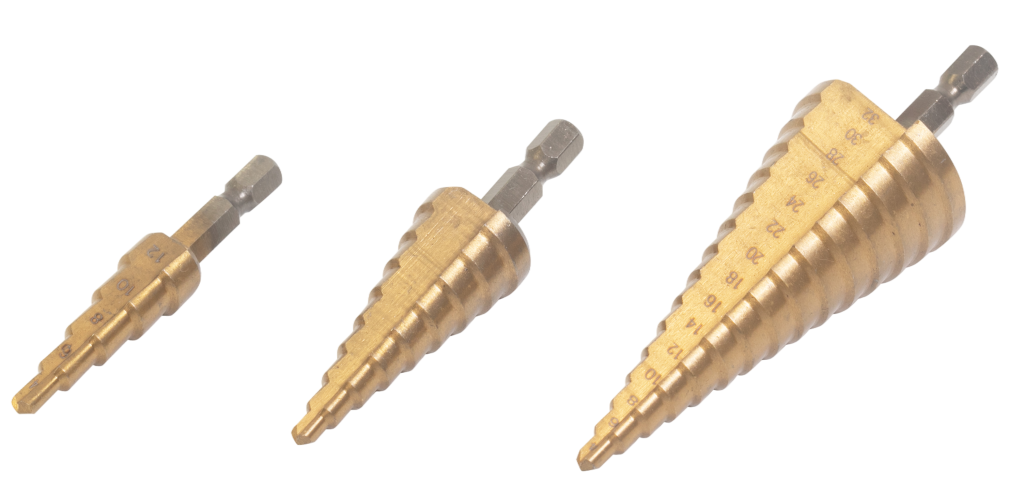
|
Recommendations for use
- Revolutions: Use low and medium RPM on the drill/screwdriver. High speeds lead to overheating.
- Cooling: When working with metal (especially stainless steel), use coolant or at least engine oil. This will prolong the life of the drill bit.
- Pressure: You need to press with moderate force, allowing the cutting edge to work. At the last stage (the largest diameter), the force increases.
- Background: Place a wooden block under the sheet material to avoid deformation of the sheet at the end of drilling.
Please note the limitations of the application
- Not for deep holes: Step drills are designed for materials up to several mm thick (usually up to 4-5 mm, depending on the specific model).
- Not for wood and stone: It is better to use conventional spiral drills for wood, and carbide drills for concrete and stone.
- Cannot be sharpened at home: When worn out, sharpening requires special equipment and skills, and it is often easier to buy a new one.
Skole step drills are a reliable choice for home workshop, garage or installation work. They perfectly cope with their main tasks: drilling neat holes in sheet materials.