
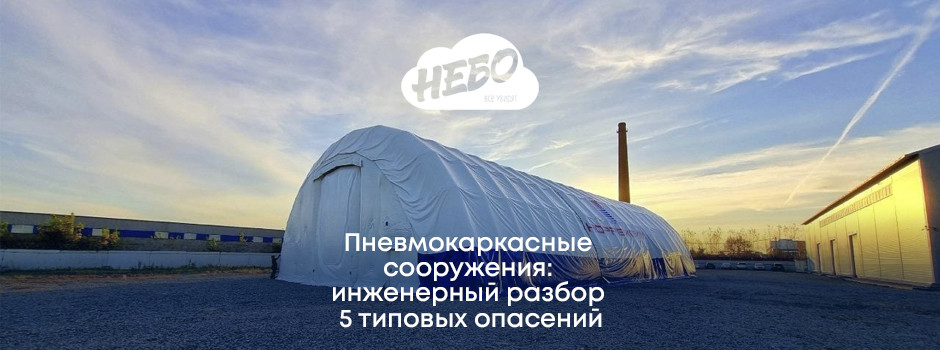
Let's analyze the five most persistent biases from the point of view of copromat and exploitation practices.
Low vandal resistance of the air tank and risk of decompression
Concern: The pneumatic cylinder is easily damaged by mechanical means, which will lead to collapse.
Technical reality:
The shell of modern RCAS is made of high-strength PVC materials with a density of 600-1100 g/m. It is a reinforced material that is resistant to tearing and punctures.
Structurally, the hangar is a system of self-contained pneumatic cylinders (arches). Even in case of critical damage to one or two sections, the rigidity of the structure is maintained due to excessive pressure in the neighboring sections. Maintainability – 100%: the defect is eliminated by gluing a reinforced patch over the gap and does not require dismantling the entire structure. As a last resort, you can limit yourself to replacing the damaged arch without interrupting the operation of the structure.
Instability of the pneumatic structure under calculated wind loads
Concern: High windage with low weight can lead to displacement of the hangar relative to the installation site, its tipping or deformation.
Technical reality:
The CCAS geometry (one and a half or optimized shape) has a minimum coefficient of aerodynamic drag. Thus, pneumatic hangars must be designed taking into account the wind area of operation, and for each specific hangar, an individual calculation of the optimal method of attaching the pneumatic structure to the surface is required. If the customer complies with all the conditions for fixing the hangar, the possibility of the hangar shifting relative to the initial installation location is completely eliminated.
Stability is provided by:
- The system of fixing the pneumatic hangar to the surface: ballast cargo, anchors and concrete slabs, screw piles.
- Dynamic rigidity:Unlike rigid frames, the pneumatic frame dampens wind shocks, redistributing energy throughout the shell.
Risk of collapse in case of power loss
Concern: If the electricity is suddenly cut off, the hangar will "fold" into machinery, storage facilities, or personnel.
Technical reality:
We manufacture pneumatic hangars with airtight, air-holding PVC fabric. As a result of this engineering solution, pumping is carried out as needed, which saves electricity and makes the system less dependent on constant power supply.
- Autonomy: The control panel holds the design geometry without pumping from 12 hours to 3 days (depending on temperature fluctuations).
- Automatic pressure control System (SARD):The system automatically turns on the pump when the pressure drops and automatically opens the relief valve when the pressure limit is exceeded — the compressors turn on only for 5-10 minutes a day to compensate for the temperature compression of the air.
Unsuitability for use in winter conditions (snow load)
Concern: Under the weight of the snow, the hangar will bend, which will lead to the collapse of the structure.
Technical reality:
The calculated trajectory of the arch contributes to the natural descent of precipitation. Therefore, a separate load calculation is performed for each of the snow areas, and the optimal shape of the pneumatic hangar is selected: the dimensions, types of gates, and operating features are taken into account. The excess pressure in the cylinders gives the arches the required rigidity, while the hangar has some mobility, which capital buildings lack. In addition, PCAS have the effect of a "thermos": a two-layer shell with an air layer minimizes heat loss and creates a temperature gradient that prevents the formation of condensation and, as a result, ice on the dome.
Short life cycle (polymer degradation)
Concern: PVC quickly loses elasticity under the influence of UV radiation and temperature peaks.
Technical reality:
Modern PVC fabrics for PCAS have a special coating that ensures:
- UV resistance.
- Biological resistance.
- Frost resistance. (Operating range from -50°C to +70°C)
- Oil and gas resistance.
- Fire safety. The PVC fabrics used correspond to the G1 flammability group, which ensures maximum safety of operation of pneumatic frame structures.
- The declared service life of the material is 15-20 years, which is comparable to the inter—repair cycle of LSTC buildings, but at the same time, pneumatic frame structures remain a mobile asset.
An air—framed hangar is not a "temporary tent", but a full-fledged engineering facility that is being built faster than a capital building and does not require construction permits.
Would you like to know if this design is suitable for your tasks? Write to us and we will develop the optimal solution suitable for your needs.