
Features:
- Provide high-quality finishing, removal performance and long service life;
- They are characterized by low heat dissipation and uniform processing;
- The non-greasing structure prevents contamination of the work surface.
Application:
- Fine grinding and polishing*
- Removal of burrs, scratches, rust;
- Rounding and blunting of edges.
*Due to the elasticity of polyamide fibers and the action of abrasive fibers, this tool is ideal for high-quality, gentle finishing.
Scope of application: surgical instruments, turbine parts, ships, aircraft engines, production of molds, dies, design products.
Processed materials:
- Steel and stainless steel;
- Aluminum;
- Titanium and heat-resistant alloys.
Circles can be made:
- Low density — soft circles for delicate processing and polishing.
- Medium density is a universal option for most operations.
- High density — rigid circles for intensive removal of material, removal of large defects.
The grain size can be:
- Coarse — rough processing, removal of large burrs, primary grinding.
- Medium — finishing, preparation for polishing.
- Fine — finishing, obtaining a smooth surface
 |
Diamond and CBN DIPAR grinding wheels on synthetic, metallic and hybrid bindings
General information
Grinding wheels are available on synthetic, metallic, and hybrid (organometallic and cermet) bundles. A wide range of shapes and sizes of abrasive grains allows you to solve various tasks related to the manufacture and re-cutting of cutting tools.
The tool on these bundles is used for grinding hard and superhard materials.
Ceramic binder (V) is made from inorganic substances such as clay, quartz, feldspar and a number of others by grinding and mixing them in certain proportions. The marking of ceramic-bonded grinding wheels contains the letter (V).
Synthetic binder (B) - mainly consists of artificial resin bakelite. Synthetic resin-based wheels have good cutting properties. This allows you to work at low speeds and relatively low cutting temperatures. Therefore, they are mainly used for sharpening and manufacturing cutting tools from hard alloys and high-speed steels. The circles on this bundle can be used to work without cooling, but if possible, you should always give preference to processing with coolant. In comparison with ceramic, synthetic ligament has greater elasticity and elasticity, heats the processed metal less, but has lower chemical and temperature resistance, and worse edge resistance.
Metal bundle (M) – mainly used for preliminary operations, removing relatively large allowances, for sharpening carbide tools, grinding products made of hard alloy, glass, ceramics, semiconductor and hard-to-process materials using coolant.
Hybrid bundle (Hb) – distinguish between metal-organic and metal-ceramic hybrid bundles. These bundles can significantly increase productivity in the production of axial tools.
Galvanic bonding (GAL) - used for cutting and grinding silicon, germanium, and other semiconductor materials, metal, and various types of technical glass. Electroplating bundles are also used for the manufacture of diamond heads, various forms of lapping, for the manufacture of hand tools from hard alloys, stamped and alloy steels .
Combinations of bundles are possible depending on the technical assignment.
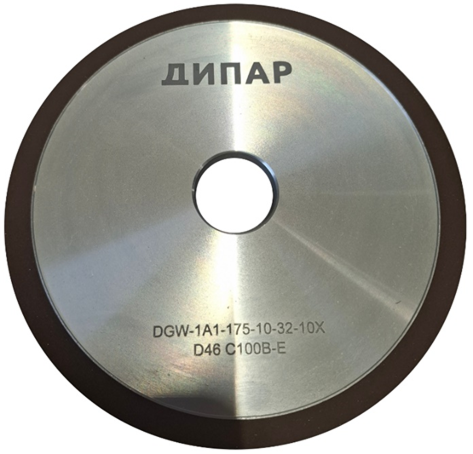
An example of the designation of diamond circles:
- DGW- diamond grinding wheel
- 1A1 - the shape of a circle
- 175 (mm) - outer diameter
- 10 (mm) is the height of the circle
- 32 (mm) - landing hole
- 10X is the height of the diamond layer
- D46 (microns) - grain size
- C100 - concentration
- B-E is a synthetic bundle
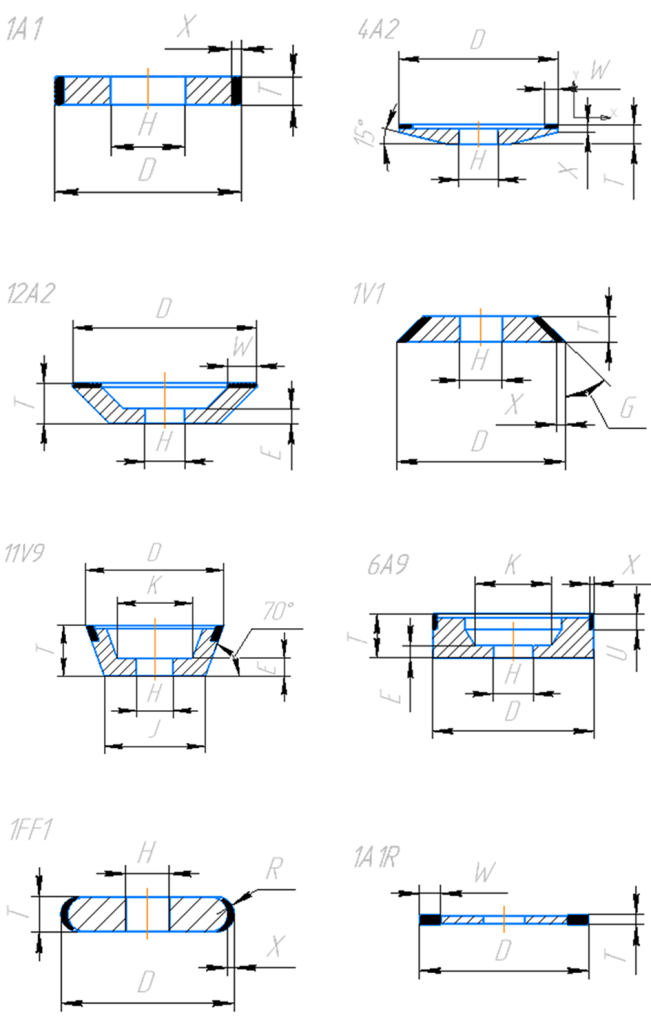
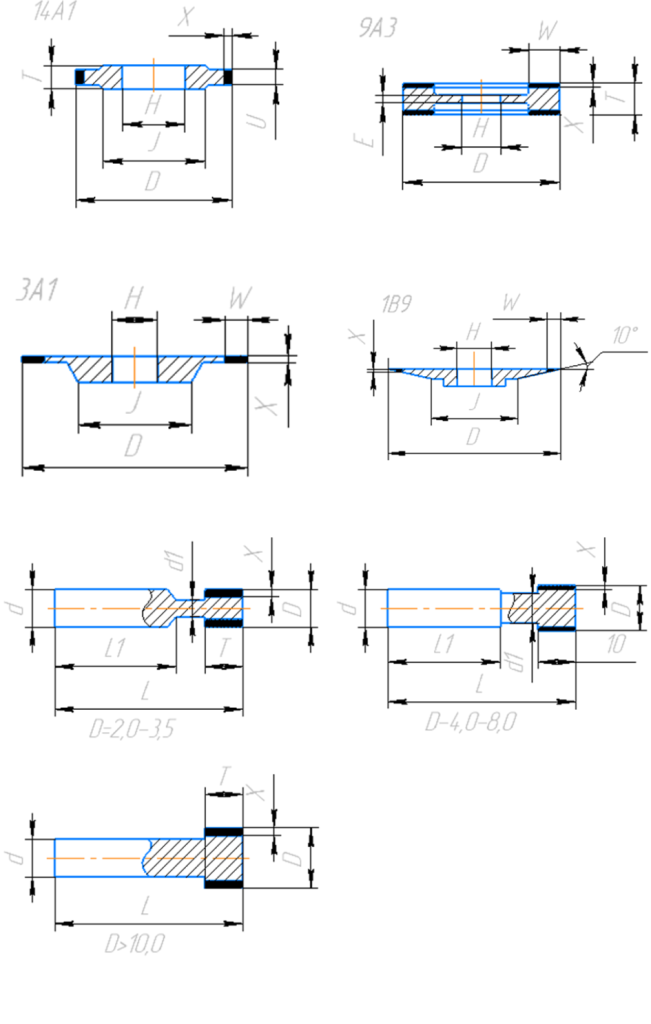
The main shapes of diamond and CBN circles
 |
 |
DIPAR® circles are manufactured on an individual request, where, depending on the equipment used and the task at hand, the ratio of grain size, concentration and type of bundle is optimally selected.
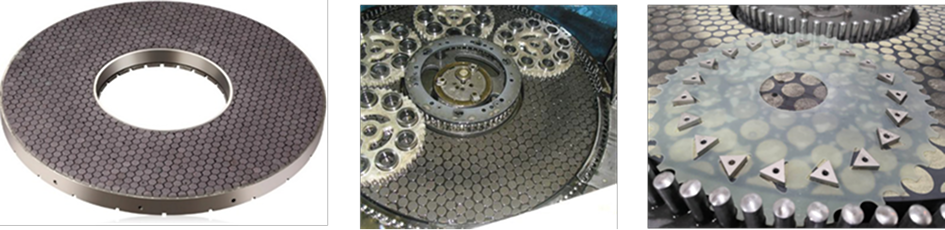
Diamond and CBN DIPAR circles on ceramic binder for grinding end surfaces
This type of circles has been gaining popularity recently. Allows you to achieve greater accuracy in flatness and parallelism of the sides.
Application:
- Hydraulic industry: valve plate, pump body, sealing parts
- Air conditioners, compressors for refrigerators: air cylinder, spool, piston, gaskets
- Automotive industry: oil pump gears, gaskets
- Ceramic industry: aluminum oxide ceramics, quartz
- Production of industrial plastics: PPS, PEEK
- Production of cutting tools: carbide plate, PCBN plate, metal-ceramic plate.
 |
A wide range of diamond and CBN grinding wheels provides for their use in various industries, for example, for grinding:
- Demanding presses
- Screw Thermoplastics machines
- Drill pipes and weights
- Crankshafts and camshafts
- High hardness parts with centerless grinding
- Sharpening of band saws, milling cutters and drills.
Combining high precision, productivity, and specialization for the most demanding materials, these solutions are expected to significantly enhance finishing efficiency in the aerospace, medical, automotive, and tool industries.