
Types of turntables
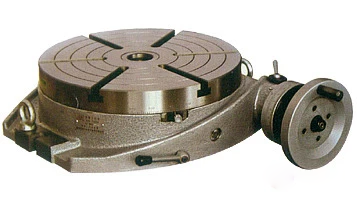
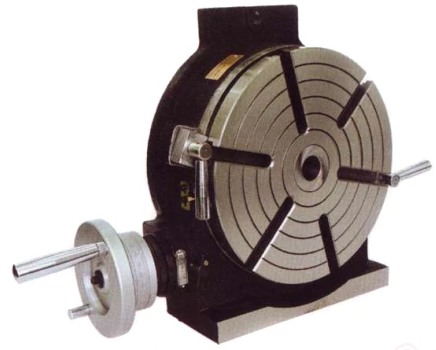
The classification of tables is based primarily on the direction of movement. There are 5 main types:
- Tiltable. It is a practical option, suitable for rotating workpieces around an axis and for their tilt in the range from 0 to 90 degrees. Convenient equipment for processing parts that do not require constant reinstallation;
- With longitudinal displacement. It is used when it is necessary to carry out milling inside flat elements made of steel holes. A number of models have a dividing disk in the device, which ensures the division of the working part into separate segments;
- Horizontal-vertical. They provide efficient processing of metal products in the horizontal and vertical planes. They are used in circular milling or, if necessary, to cut screw grooves;
- Horizontal. A versatile type of equipment, characterized by ease of operation. It is used for drilling in a circle;
- With longitudinal and transverse displacement. It is recognized as the most technologically advanced equipment that significantly expands the functions of the milling machine. It provides complete rotation of workpieces and simplifies the processing of elements that are complex in configuration and location of corners.
|
|
Design and scope of application
A rotary table for a milling machine, regardless of its class, has a standard device:
- The base or otherwise the bed. In a powerful design, a mandatory element is the locking system to the machine;
- Faceplate. It is a rotating element with a straight or cone-shaped hole in the center. Slots are provided in the working plane in which the workpiece or the clamping mechanism is fixed. After fixing the faceplate part, it must be firmly fixed in the selected position;
- A mechanism for controlling the structure. The rotation of the faceplate is provided by an electric motor or a manual mechanism. Some of the models are programmable, meaning they can be controlled from a computer.
The convenience of use is explained by fixing the part not on the machine bed, but in the additional device itself. Due to this, the workpiece acquires an axis of rotation, that is, it can be rotated in the horizontal and vertical planes.
The equipment is used both on individual simple installations and on automated lines. Not only milling and vertical drilling machines can be combined with tables, but also presses and hammers for forging. They are also used in welding processes, ensuring the accuracy and relief of welding.
Rotary tables are designed according to GOST. They must be selected taking into account the specifics of work on a milling machine.