
Main characteristics of the tools
Metal drills have a number of properties, among which the main ones are:
- hardness;
- heat resistance;
- wear resistance.
Hardness determines how strong metals a tool can "take".
Due to its heat resistance, the drill retains its hardness when heated, which inevitably occurs during operation.
The wear resistance determines how long the drill edges keep sharpening. The lower its value, the more often you have to sharpen the tool.
Note that drill manufacturers do not specify the listed characteristics in the product description. The hardness, heat resistance and wear resistance of products can be assessed by their marking and how the tools manifest themselves when used.
Classification of drills by their type and purpose
Drills are divided into different types according to a number of parameters:
- constructions;
- the type of shank;
- the manufacturing method.
Drill bit design
This parameter determines not only the appearance of the product, but also the tasks that it allows you to perform.
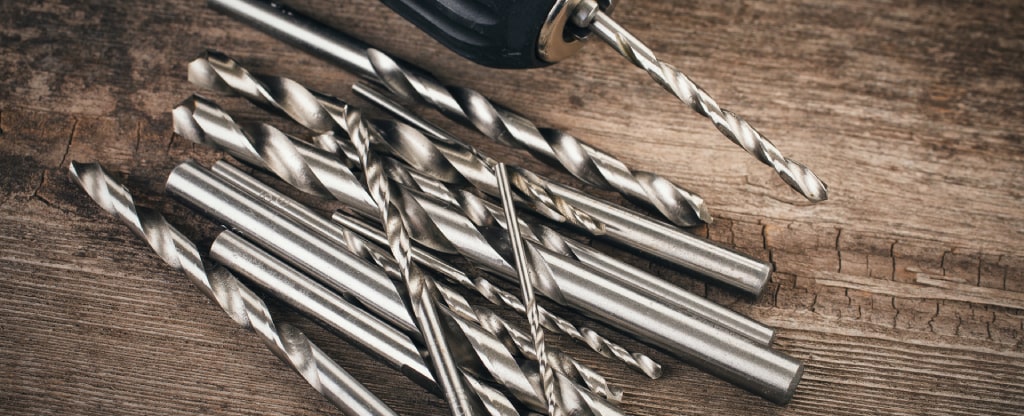
Spiral drill bit
The working part of this tool looks like a cylindrical rod with two screw cutting edges and recess grooves that serve to remove chips.
Such equipment is used for drilling blind and through holes, including deep ones. The working part has the same diameter along its entire length. This means that the tool allows you to create holes of only one diameter.
Core drill bit
As in the previous case, the working part of the drill has a cylindrical shape. The design includes a twisted cutting edge and a groove for chip removal. The core drill is hollow. Its end part has many notches. This makes the instrument look like a crown and explains its name.
Step drill bit
The working part of such a product is made in the form of a cone, along the entire surface of which there are steps. Each of them is designed for drilling holes of a certain size.
The diameter increases sequentially — from the tip to the shank. The step drill allows you to create holes of the desired size without replacing the tool in the chuck.
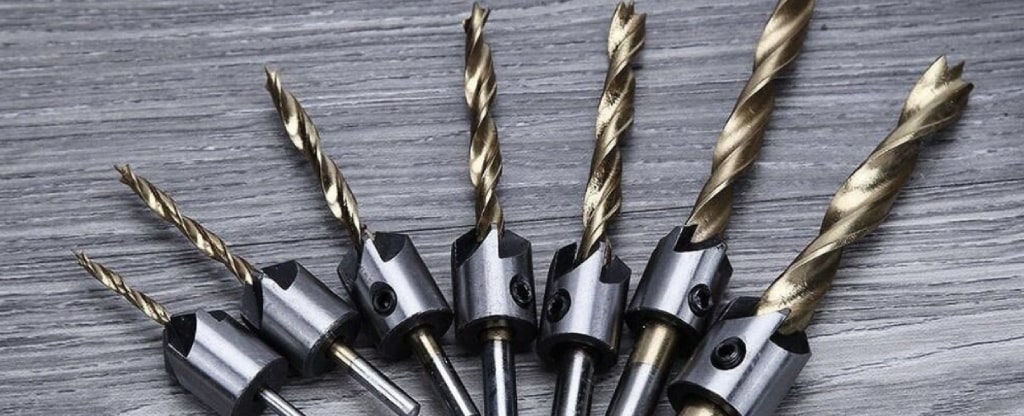
Countersink
Sometimes this tool is placed in a separate category. Its working part has a conical shape and is equipped with longitudinal cutting notches. The countersink is used to create conical holes or expand previously formed cylindrical holes.
This tool is designed for semi-finishing workpieces: it improves surface quality and improves cutting accuracy.
 |
Shank type
Another important parameter to consider when choosing a drill bit. An error will cause the tool to not fit the drill, screwdriver, or machine tool.
Cylindrical
It has the shape of a smooth cylinder with a smaller diameter than the working part. The advantage of the cylindrical shank is the easy rotation of the drill, even when deeply immersed in metal.
The cylindrical shank is compatible with tools such as:
- household screwdrivers;
- drills with quick-release and key chuck;
- low-power drilling machines.
Hexagon
The six sides of such a shank smoothly merge into the working base. Compatible with different cartridges: quick-release, key, hex. It should be noted that the hexagonal chuck most fully reveals the potential of such equipment, since it does not require unscrewing and twisting during installation and removal. However, it is important to keep in mind that due to strong vibrations, the tool may fly out of the cartridge.
Hex shank drills are used for:
- household drills;
- drills and screwdrivers.
Conical
Drills with conical shanks are designed for industrial drilling machines. They are not suitable for household drills, screwdrivers and rotary hammers. The conical shank is a thin cone with a taper to the end.
The advantages include the simple installation of a drill with a conical shank: you just need to insert the tool into the chuck with effort. This method does not require the use of additional devices and helps to save time.
Manufacturing method
This parameter determines the strength and durability of the tool. In addition, it affects the cost of tooling. Let's consider the types of drills according to the manufacturing method.
Solid
These are drills with the simplest production technology. Such tools are solid products made of a single material, usually steel. The alloy is poured into a mold, which results in a blank for the future drill bit.
Welded
This type of equipment is represented by core drills. The essence of the manufacturing method lies in the fact that two separate parts — the crown bowl and the stem with the shank — are connected by welding. This technology makes it possible to optimize production and reduce the cost of products.
A high-quality alloy is used to manufacture the working part, which takes on the entire load. At the same time, the shank is made of inexpensive carbon steel.
Carbide
The base of drills of this type is made by casting. In this case, the alloy is high-speed steel. Another material is used to make the tip, an expensive hard alloy VK8.
Carbide drills have the following features:
- durability;
- resistance to high temperatures;
- high efficiency when drilling durable metals.
Note that a worn-out carbide drill tip can be replaced with a new one. This prolongs the life of the product.
 |
Comparison of drill materials
The hardness, heat resistance and wear resistance of the tooling directly depends on the material it is made of. As a rule, high-speed steel is used in the production of drills. The manufacturing material is indicated in the marking with the letters P or HSS.
The alloys from which the highest quality drills are made include special additives. They are also displayed in the labeling:
- The P — alloy contains tungsten.
- F — the alloy contains vanadium.
- The M — alloy includes molybdenum.
Let's figure out how to use labeling to determine the material of tooling manufacture.
HSS-E
The designation HSS-Co is also used. These are wear-resistant heat-resistant drills made of an alloy with a cobalt content of up to 8%. Its presence ensures high efficiency when drilling holes in stainless and alloy steel with a strength of up to 1200 N/mm2.
HSS-TiAIN
The peculiarity of such drills is the presence of a special coating. It consists of three layers: titanium, aluminum and nitride. Spraying allows the drills to withstand temperatures reaching up to 900 °C. In addition, the coating significantly increases the efficiency of the tool.
HSS-TIN
Drills of this type have titanium nitride coating. It performs two tasks at once: it increases the strength of the tooling and makes it resistant to temperatures up to +600 °C. These tools are suitable for drilling holes in aluminum, cast iron, alloy and carbon steel.
HSS-G
This category of equipment is the most popular. The advantages of such drills include affordable cost and a wide range of tasks that they help to perform. The high strength of the products is ensured by grinding the cutting edge with boron nitride. Such tools are actively used for drilling cast iron and steel.
HSS-R
Products with this marking are designed to work with cast iron and soft metals. After hardening, the drills are rolled with a roller. The advantages of such tools include low cost, the disadvantages are low durability and limited resource.
Important: The material of the carbide drill tip must be specified separately.
 |
How to choose a metal drill bit: additional criteria
The list of parameters to consider when purchasing a snap-in is not limited to those listed above. Other criteria should also be considered.
Drill diameter
The size of the hole depends on this parameter. Spiral and step drills are used to drill narrow holes, while crown drills and countersinks are used to create wide ones.
Tool length
What matters here is how deep the hole should be. If there is a lack of length, you can use additional equipment in the form of an extension cord for the drill.
Accuracy
Drills are divided into three accuracy classes:
- B;
- B1;
- A1.
The difference between the classes lies in the qualifications, i.e. degrees of tolerance:
| Drill precision class | Accuracy, qualities | Purpose of the tool |
|---|---|---|
|
B |
15 |
Drilling holes that are not subject to strict requirements |
|
B1 |
14 |
Creating semi-violent holes |
|
A1 |
10-13 |
Drilling holes with the highest possible accuracy — up to 0.1 mm |
A1 class products are expensive. Buying such tools makes sense only if absolutely necessary.
 |
Cutting direction
Drills with a right-sided cut are most often found. A left-hand-cut tool is used to perform a specific task, namely, removing broken fasteners. Due to the design features of the tooling, the stuck fastener is not rotated, but drilled.
Sharpening angle
The choice of a drill according to this parameter depends on what kind of material is to be processed:
|
Sharpening angle |
Drilling material |
|---|---|
|
130–140° |
Steel, bronze |
|
110–120° |
Cast iron, brass, duralumin |
|
100° |
Soft metals |
Product color
The shade may indicate the material of the drill bit or additional processing that improves the characteristics of the tool and is indicated in the marking.
Grey (HSS)
There is no processing. The properties of the tool are determined by the steel grade. When sharpening, the drilling quality does not decrease.
Golden color (HSS)
The shade indicates quenching followed by release. Such tools are characterized by impact resistance and reduced brittleness.
Black (HSS-R)
The color indicates steam treatment — steam oxidation. This is a simple method to increase wear resistance and corrosion resistance. In addition, vapor oxidation reduces the adhesion of chips to the tool and facilitates the formation of shallow holes in viscous metals.
Important:Steam-oxidized tooling should not be confused with cheap products made of high-carbon black steel.
Bright metallic color (HSS-G)
The gloss of the products is provided by polishing with boron nitride. This treatment increases the productivity of the tool and improves its wear resistance. The tooling with a bright metallic sheen is suitable for drilling shallow holes in viscous metals.
Bright golden color (HSS-TIN, HSS-TiAIN)
Drills with titanium nitride or titanium-aluminum-nitride coating have this shade. The special layer improves the wear resistance and cutting properties of the tool, while reducing friction and heat. Note that the wear of the coating and sharpening negatively affect the characteristics of the drill.
Bronze or brown-gold shade (HSS-E, HSS-Co)
The color makes it clear that the alloy used in the manufacture of the drill contains cobalt. Such tools are characterized by high hardness and wear resistance, and retain their original characteristics when sharpening. They are used for drilling cast iron, stainless steel and alloy steel. Designed for professional equipment.
Conclusion
When choosing a metal drill, it is important to consider a whole range of criteria, otherwise you may make a mistake. In addition, we recommend that you take into account the specifics of the tooling application.
For example, ordinary HSS drills are sufficient for household purposes. For frequent metal work, it is better to choose tools marked HSS-R or HSS-G.
To drill holes in cast iron and hard steel, products with titanium nitride or titanium-aluminum-nitride coating are suitable. Long-term work with all types of metals requires the use of cobalt drills marked HSS-E (HSS-Co).
 |